Last visited: late April 2026. Hi, I am MATSUI — a Japanese onsen lover who has stayed at more than 50 ryokans across Japan and visits a new hot-spring town roughly every two months. This Spoke focuses on the kaiseki meals at Yarimikan, the hidden ryokan in Okuhida — Night 1 Yoshun course, Night 2 with live iwana and A5 Hida beef, the Hida-style breakfast set, the optional Day-2 lunch.
What you’ll learn in this guide
- The full lineup of the Yoshun spring kaiseki course on Night 1 — eleven dishes from hassun to dessert
- How Night 2’s menu rotates completely — live iwana sashimi, A5 Hida beef on volcanic stone, and karin (Japanese quince) wine
- What the Hida-style Japanese breakfast set actually looks like, and why the ramen is an accent rather than the main
- The optional Day-2 lunch — and the reservation-timing rule that international guests miss
Quick Take
| Dinner style | Hida-region kaiseki — Hida beef, river fish, spring vegetables |
| Standout dishes | Spring-greens steamed sea bream, hoba-yaki Hida beef, live iwana sashimi, A5 Hida beef on hot stone |
| Two-night perk | Night 1 and Night 2 dinners are completely different menus — not a partial swap |
| Breakfast | Hida-style Japanese set — hoba miso, fresh tofu, eight-compartment jubako, plus one bowl of Takayama ramen as accent |
| Lunch on Day 2 | Available for two-night guests — reserving when you book is recommended for the full experience including the signature tsukemono steak hoba-jitate |
Planning a two-night stay? The Day-2 lunch and the kids’ kaiseki need to be requested at the time of booking — the kitchen pre-orders ingredients. Reserve directly through the inn’s English page so the dietary notes and meal options below come through to the chef.
The Setting: A Song-Dynasty Zen Poem on Every Place Mat
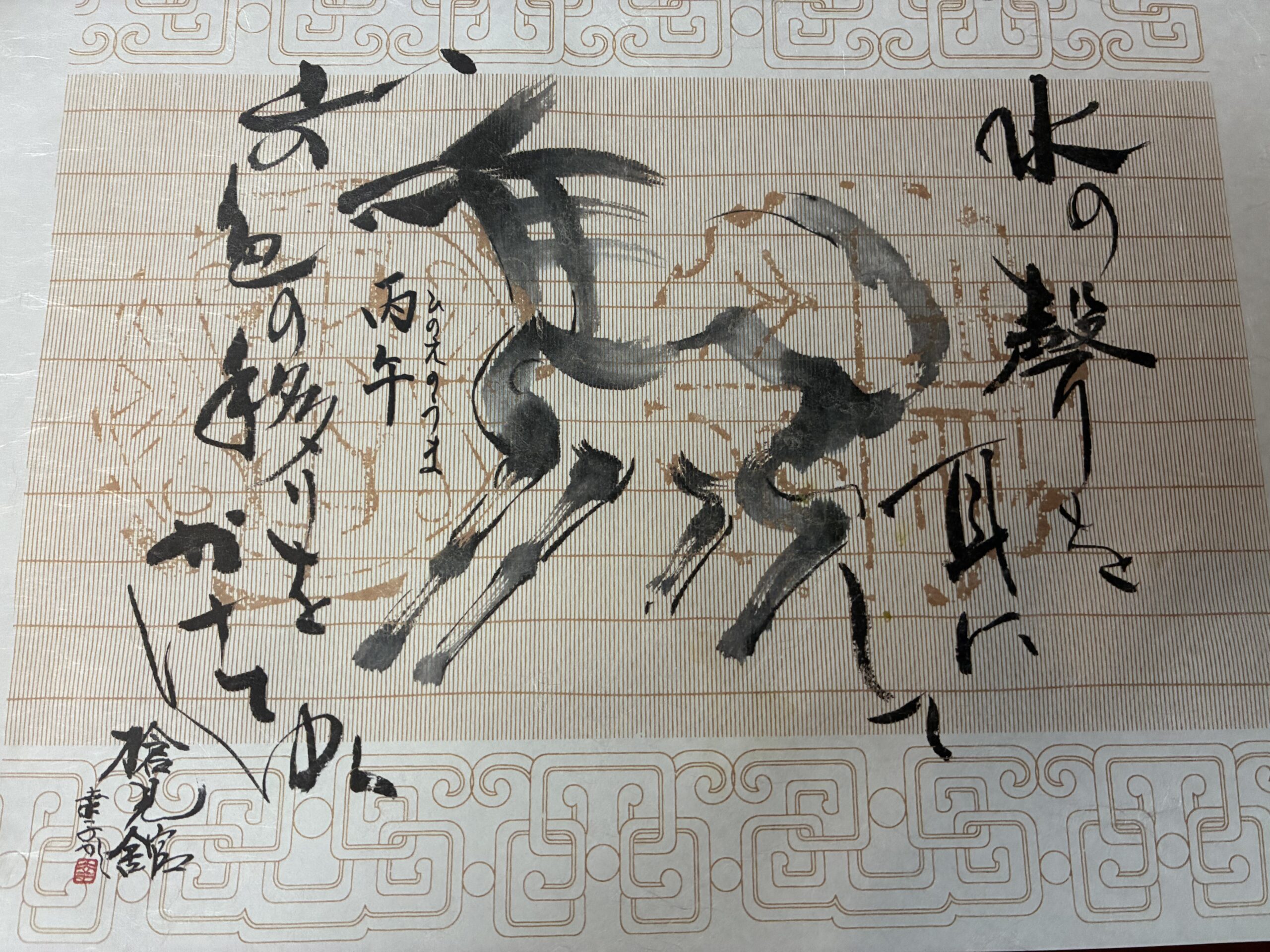
When you take your seat in the dining hall, the first thing you notice isn’t the food. It’s the paper place mat in front of you. A line of Japanese calligraphy runs along the top — and once you know what it points to, the rest of the meal reads differently.
The line is drawn from a Zen poem called Keisei-Sansyoku (渓声山色), or “The Sound of Mountain Streams, The Color of Mountains.” The poem was written nearly a thousand years ago by Su Shi (also known as Su Tongpo, 蘇軾, 1037–1101), one of the most celebrated poets of China’s Song dynasty. The opening couplet reads:
The voice of the valley stream is itself the long, broad tongue of the Buddha;
— Su Shi, Keisei-Sansyoku (Song dynasty, 1037–1101)
the color of the mountains — how could it be anything but his pure body?
In Zen reading, the river isn’t just a river and the mountain isn’t just scenery. The sound of water is the Buddha’s sermon; the color of the mountains is the Buddha’s body. Nature itself is the teaching, if you know how to listen.
Yarimikan takes that idea and lays it directly under your dinner. The place mat carries a single brushed line — written in a calligraphic hand — that quotes the poem in the inn’s own voice:
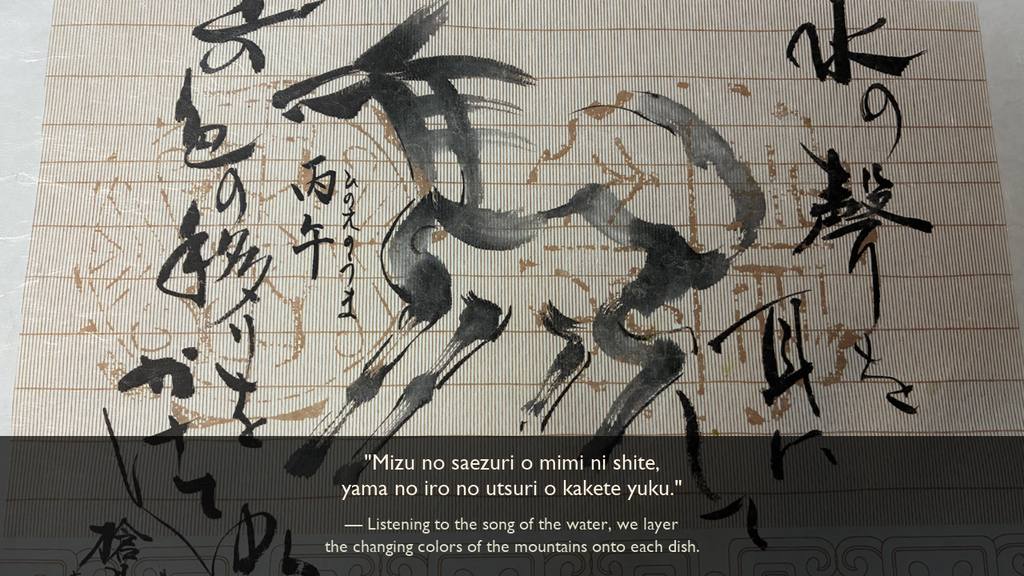
“Mizu no saezuri o mimi ni shite, yama no iro no utsuri o kakete yuku.”
— from Keisei-Sansyoku, a Zen poem by Su Shi (Song dynasty, 1037–1101), brushed onto each dining-hall place mat at Yarimikan
Listening to the song of the water, we layer the changing colors of the mountains onto each dish.
The geography backs the poem up. The Kamata River runs just below the dining hall windows; you hear it through the entire meal. The Hotaka mountains rise straight up on the other side. The kitchen’s choice of Su Shi isn’t decoration — it’s a thesis. The river you can hear is the sermon. The mountains you can see are the body. And across the dinner course, the kaiseki on your table is the inn’s attempt to put both onto a plate.
Once you read the place mat, every course that follows reads as a sentence in the same poem. River fish for the sound of the water. Mountain vegetables and bamboo shoots for the color of the slopes. A steamed amadai called Haru-Midori — “Spring Green” — for the moment in late April when the snow line retreats and the first leaves come in. The menu isn’t a list of ingredients. It’s a translation of the view outside.
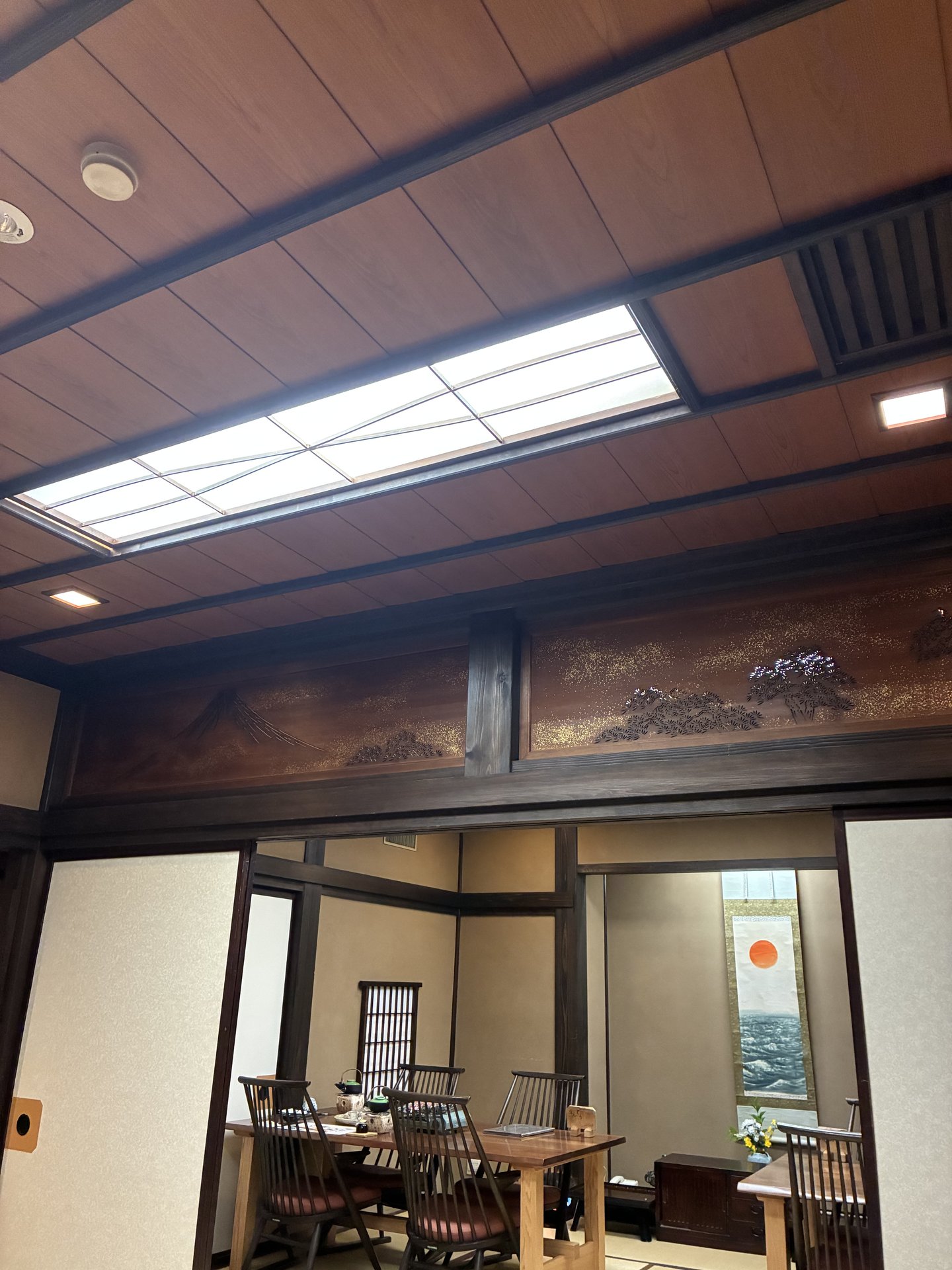
Dinner is served in a shared dining hall, but the room is divided into private screened spaces, so each party has its own pocket of quiet. You hear the river. You hear cutlery on lacquer at the next screen over, faintly. You don’t hear conversation from other tables. It’s the closest a shared dining room gets to in-room kaiseki without actually being in your room.
Dinner Night 1: The “Yoshun” Spring Course
The first night’s dinner is called Yoshun — literally “spring sun.” The whole course is built around early-spring ingredients from the Hida region, plated to suggest sunlight returning to the mountains.
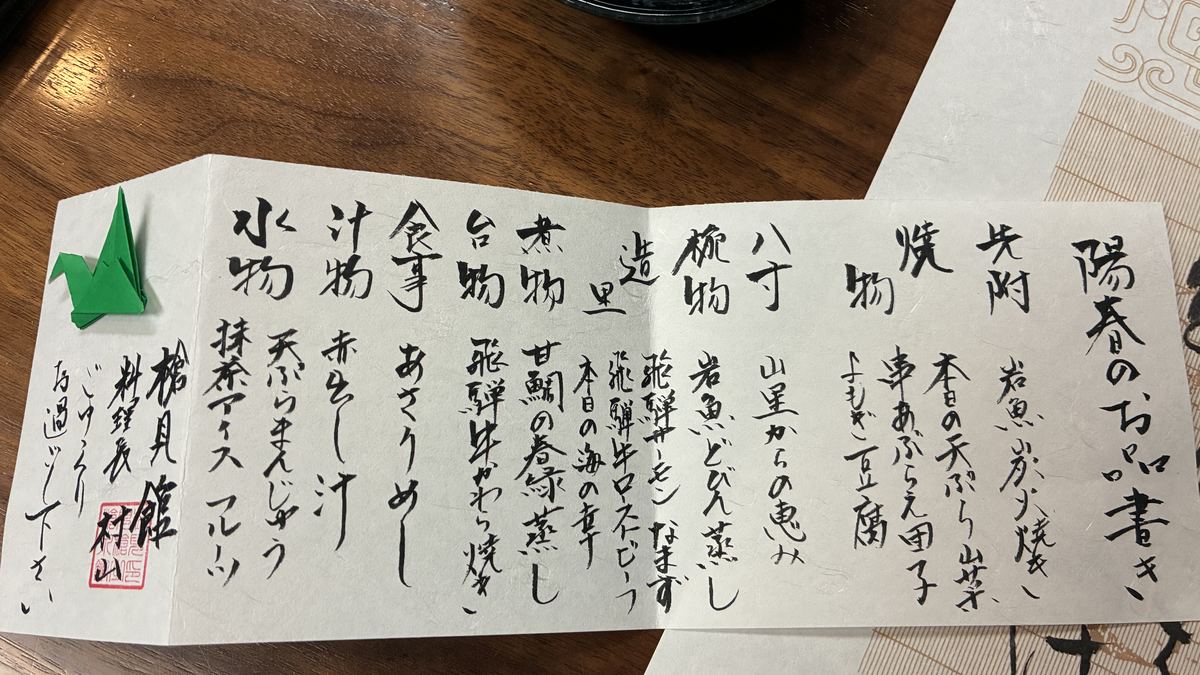
Full Course Lineup
| Course | Dish |
|---|---|
| Aperitif | Plum wine — umeshu |
| Hassun — appetizer plate | Bounty of the mountain village |
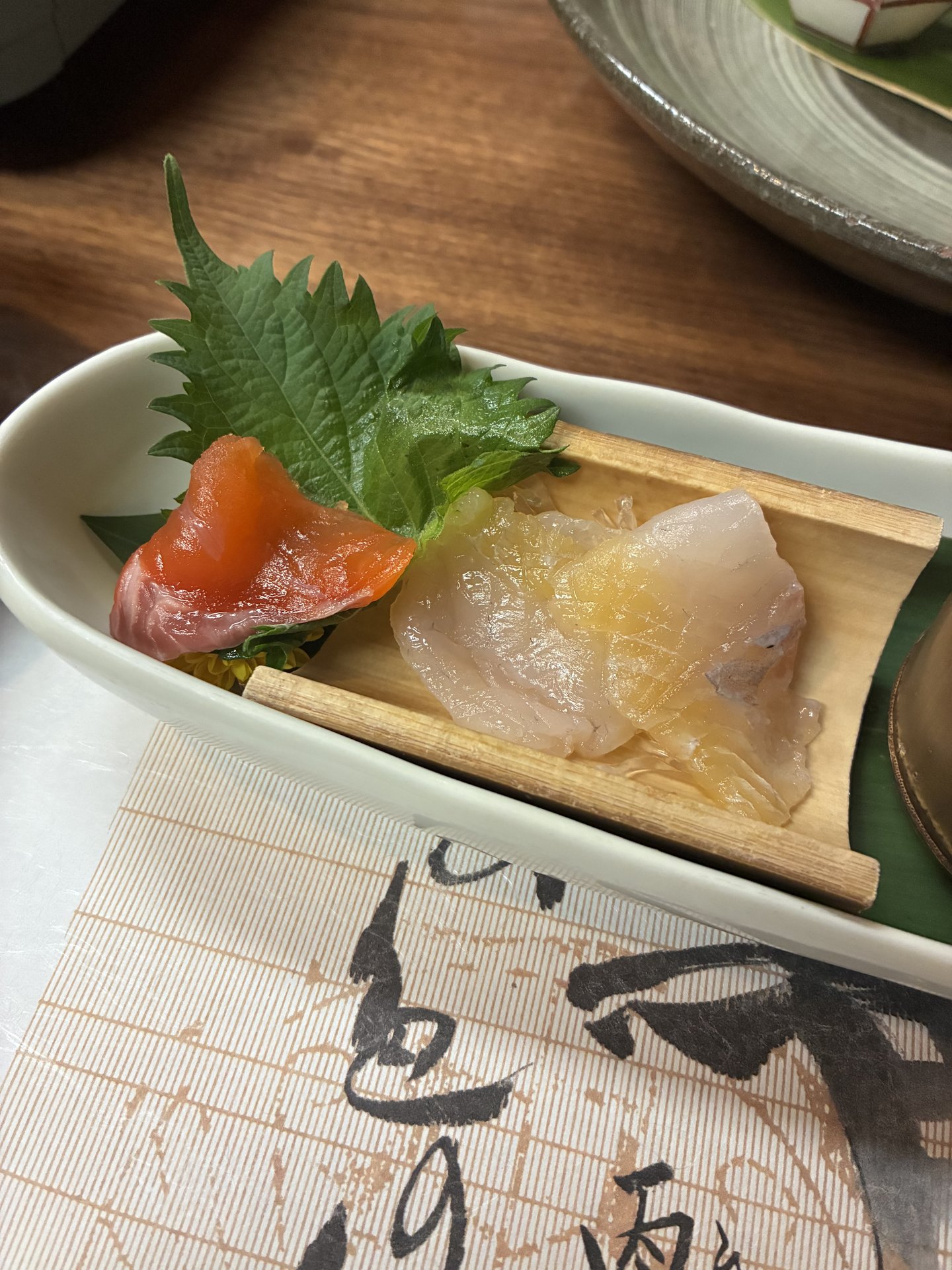
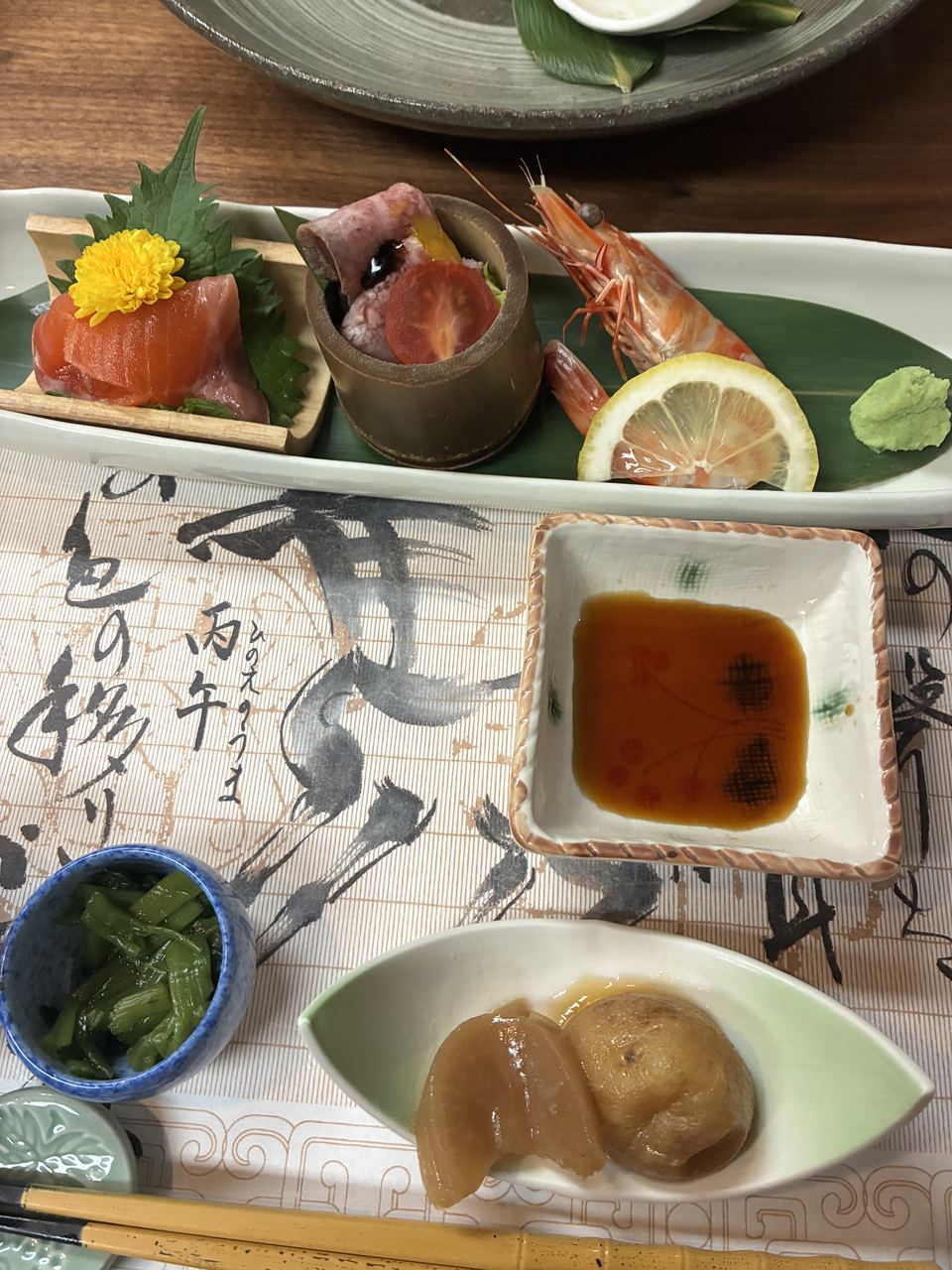
| Sashimi | Hida salmon / Hida catfish / Hida beef roast / shrimp |
| Grilled | Salt-grilled ayu — sweetfish |
| Tempura | Mountain vegetables, kushikatsu skewers, ganmodoki tofu |
| Simmered | Shungiku and white-fish steam |
| Steamed | Spring-greens steamed sea bream with bamboo shoot and scallop |
| Main | Hida beef hoba-yaki — grilled on a magnolia leaf |
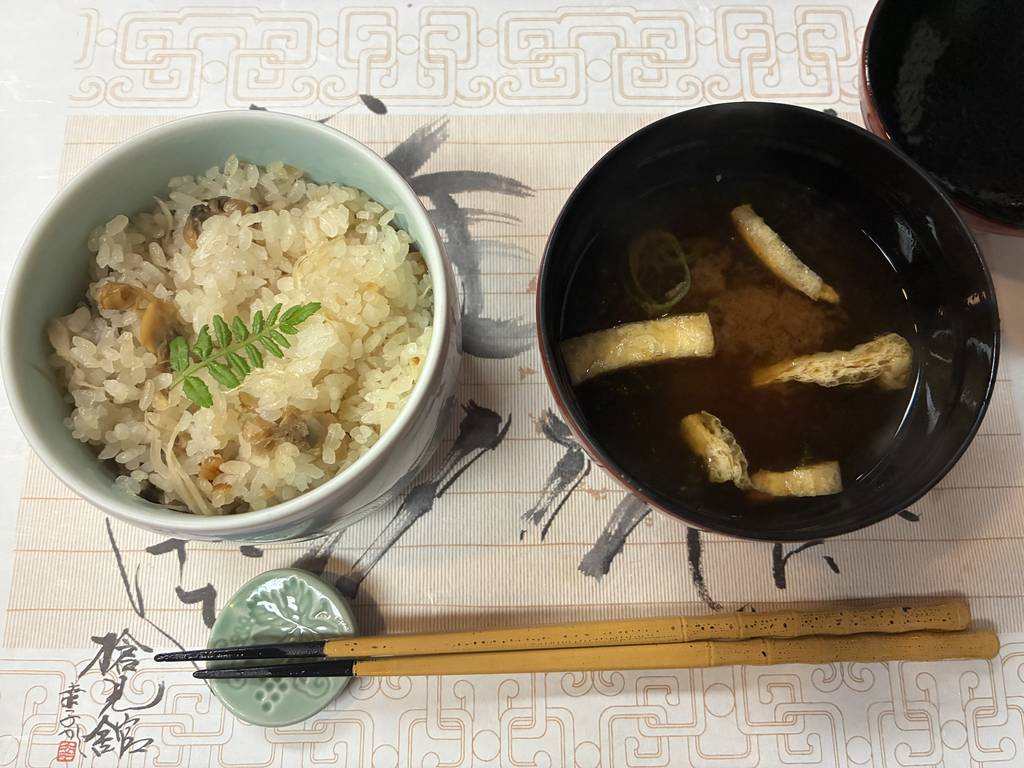
| Rice | Asari clam rice |
| Soup | Asari clam broth |
| Dessert | Tempura manju, matcha ice cream, seasonal fruit |
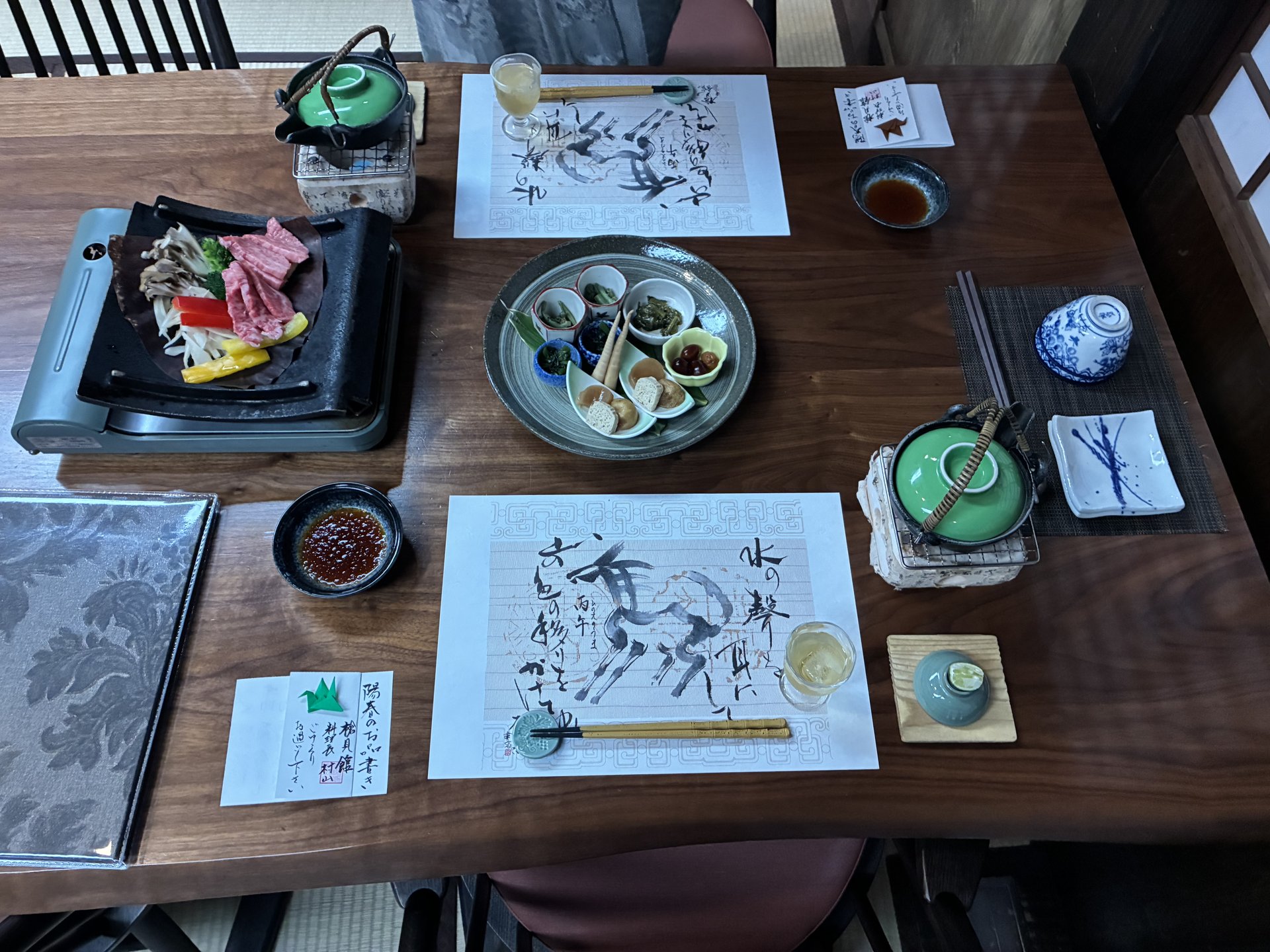
Standout Dishes — and Why They Matter
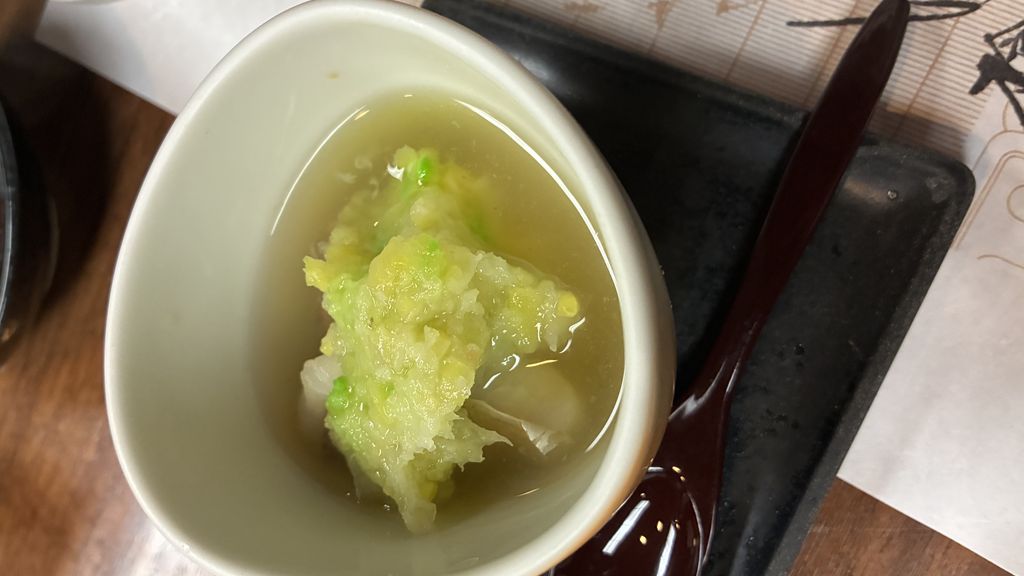
Spring-Greens Steamed Sea Bream — Amadai no Shunryoku-mushi
The kanji shunryoku literally means “spring green,” and the dish lives up to it. Sea bream is steamed with bamboo shoots and scallops on a bed of bright green vegetables. The bamboo shoot still has the snap of early-spring harvest, and the scallop sweetness rounds out the delicate sea bream. This is the dish that telegraphs “April in Okuhida” most clearly.
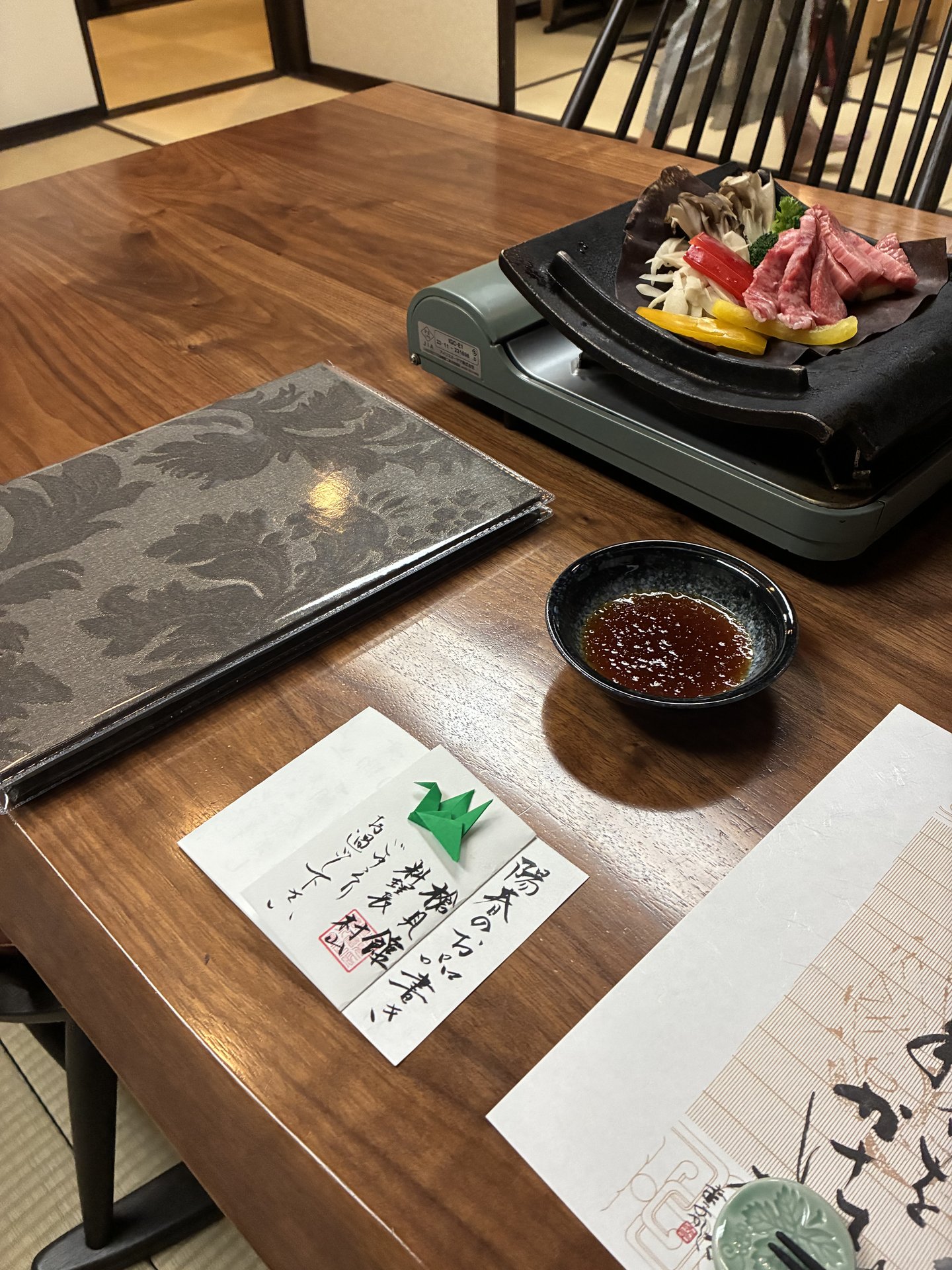
Hida Beef Hoba-Yaki
A signature method of the Hida region — Hida-grade beef grilled on top of a dried magnolia leaf with miso. The leaf scents the meat as it cooks. If you visit Hida and skip hoba-yaki, you have missed the local culinary identity. The portion at Yarimikan is generous but not overwhelming, which sets the tone for the rest of the course.
↑ A 15-second clip of the A5 Hida beef cooking on the heated volcanic stone — the marbling melting on contact at the table.
Hida Catfish — Hida Namazu — in the Sashimi
This one surprises most international guests. Catfish, raw? Yes — and it has none of the muddy river-fish flavor that Western diners might brace for. The flesh is white, mild, almost buttery. It is one of those uniquely Okuhida ingredients you won’t easily find in Tokyo or Kyoto kaiseki.
Hida Beef Roast on the Sashimi Plate
A cube of cold-roasted Hida beef sits beside the salmon and shrimp. Seeing this quality of beef appear on a sashimi plate at a mountain inn tells you something about the supply chain in the Hida region — the beef comes from nearby ranches across Hida.
Aperitif: Plum Wine
The opening drink on Night 1 is a clean, lightly sweet plum wine. It rinses the palate before the course begins and pairs well with the warm hassun appetizers.
Rice Course Finale: Asari Clam Takikomi
The rice course on Night 1 is asari clam takikomi — clam meat folded into rice cooked in clam broth — paired with a small bowl of the same broth as miso soup. After eleven small courses, this is the quiet, salt-and-umami close that lets the kaiseki land.
Dinner Night 2: A Completely Different Menu
This is where Yarimikan separates itself from typical Japanese ryokans. Most inns that offer consecutive-night packages will swap out one or two dishes on Night 2 — perhaps a different protein, a new appetizer plate. At Yarimikan, the entire menu changes. Different aperitif, different sashimi, different cooking methods, different desserts. Two nights, two complete kaiseki experiences.
The Night 2 menu is also signed by Head Chef Murayama Jun, with the same calligraphic place mat and a fresh seasonal heading.
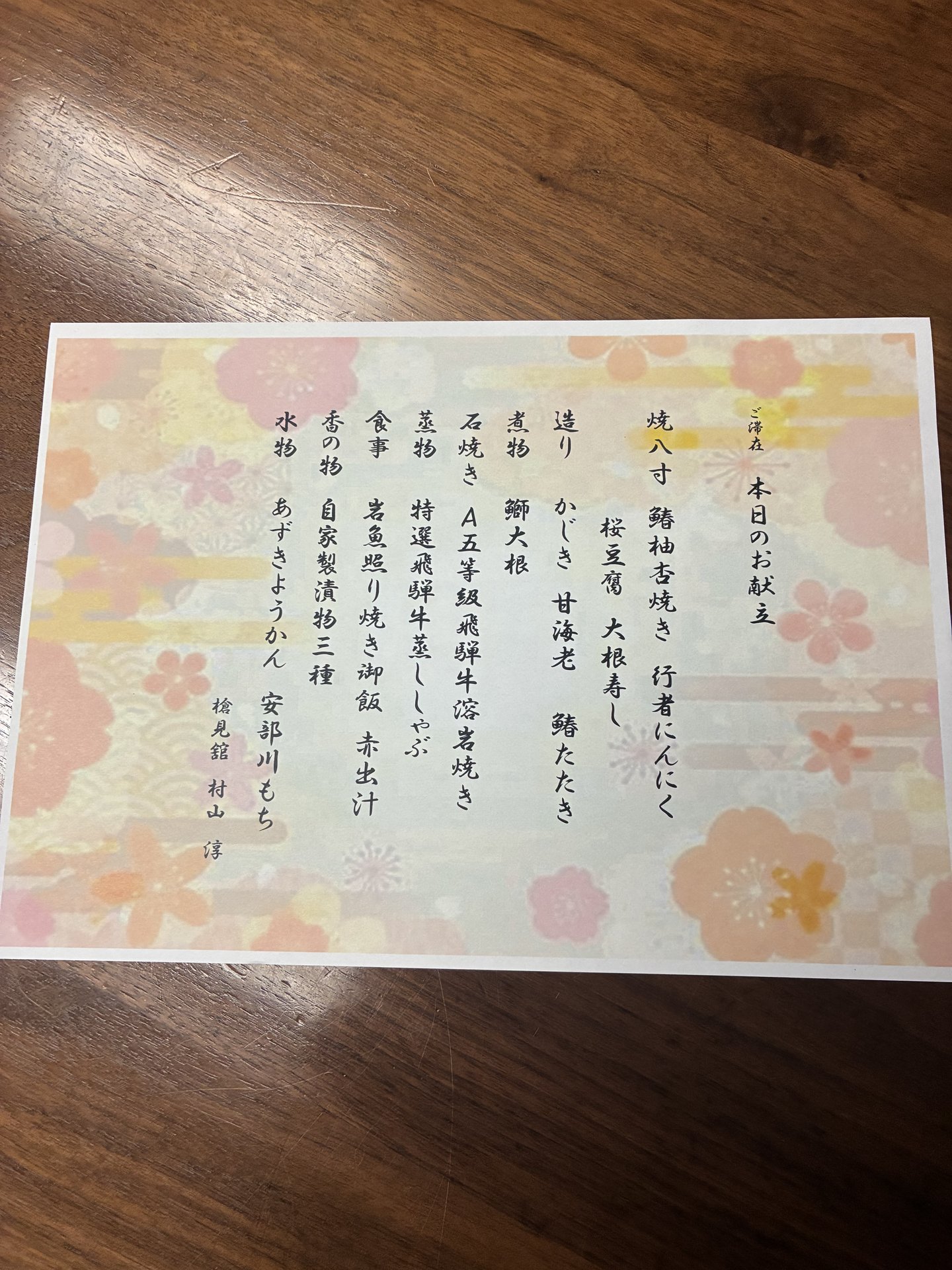
Standout Dishes on Night 2
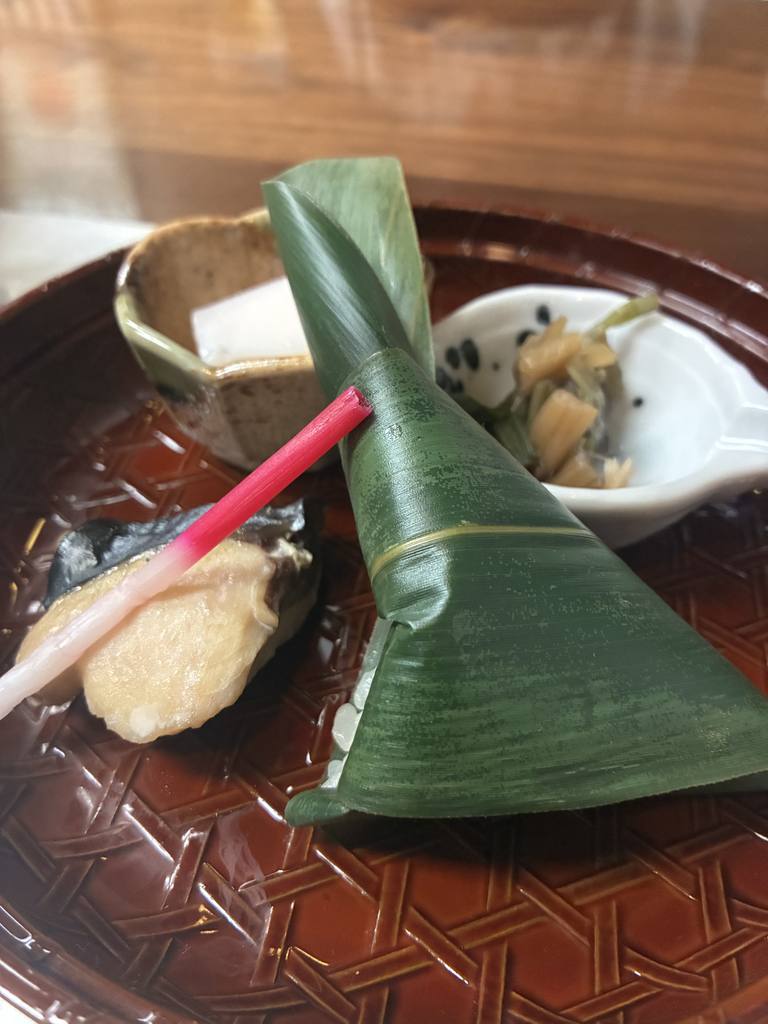
Yakihassun: Bamboo-Leaf-Wrapped Grilled Appetizer
The Night 2 hassun is a yaki-hassun — a grilled appetizer plate. A scallop, white-dressed seasonal vegetables, and other bites are wrapped or arranged around a bamboo leaf parcel that has been gently grilled. The bamboo leaves give the dish a faint scent of the mountains before you even unwrap them, and they signal the more elaborate evening to come.
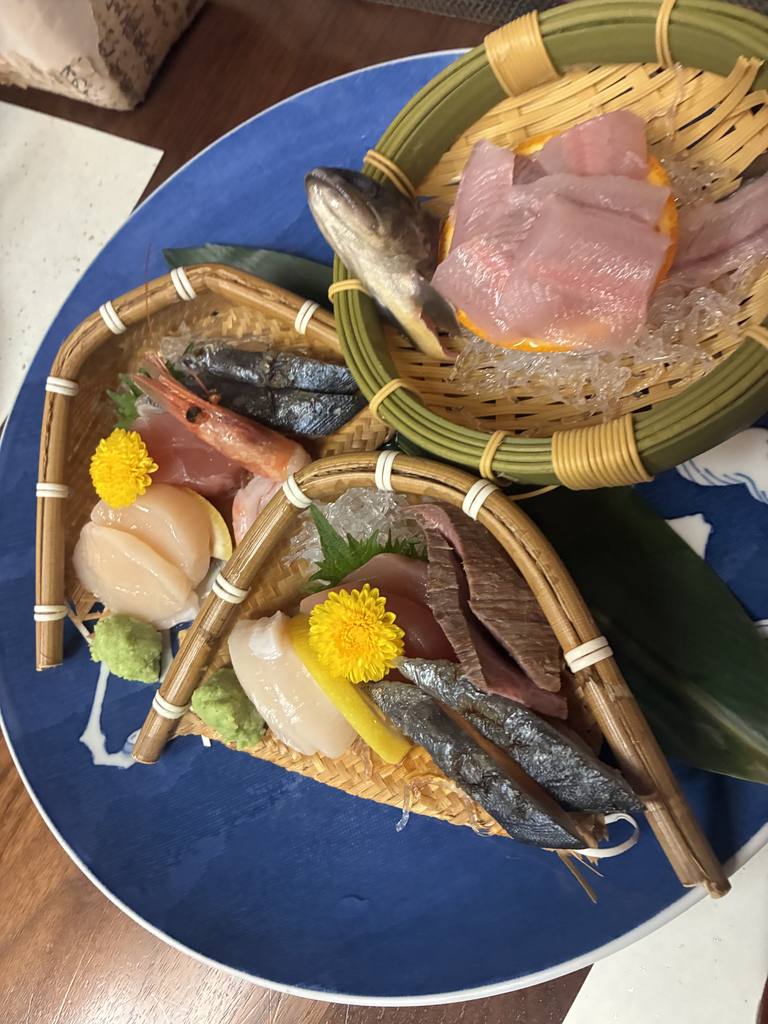
Iwana Live Sashimi — Iwana no Ikizukuri
This is the dish that surprises everyone. The iwana — a Japanese mountain trout — is served as live sashimi. When it arrives at the table, the fish is still moving on the plate. I am a Japanese guest who has eaten kaiseki at over fifty ryokans, and even I reached for my phone to record it. There is no muddiness or river-fish off-flavor — just firm, clean white flesh. The presentation can be intense for first-time visitors; if you would prefer the iwana prepared otherwise, please tell the inn when you reserve so the kitchen can plan ahead.
↑ A 52-second clip of the Yoshun spring kaiseki at the table — the calligraphy place mat, the hassun plate, and the spring-greens steamed sea bream.
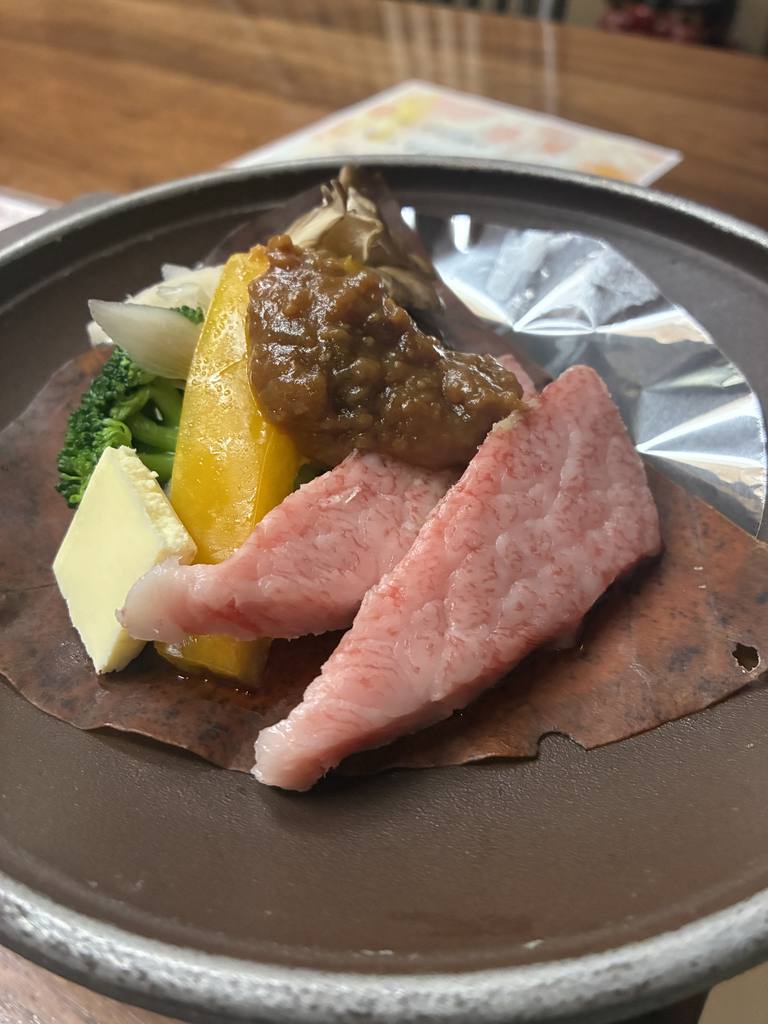
A5-Grade Hida Beef on Volcanic Stone
A small slab of A5-grade Hida beef cooks at the table on a heated volcanic stone. The first bite is the kind that makes you stop talking. The marbling melts almost on contact. This is the dish that justifies the “Hida beef” reputation in a single mouthful.
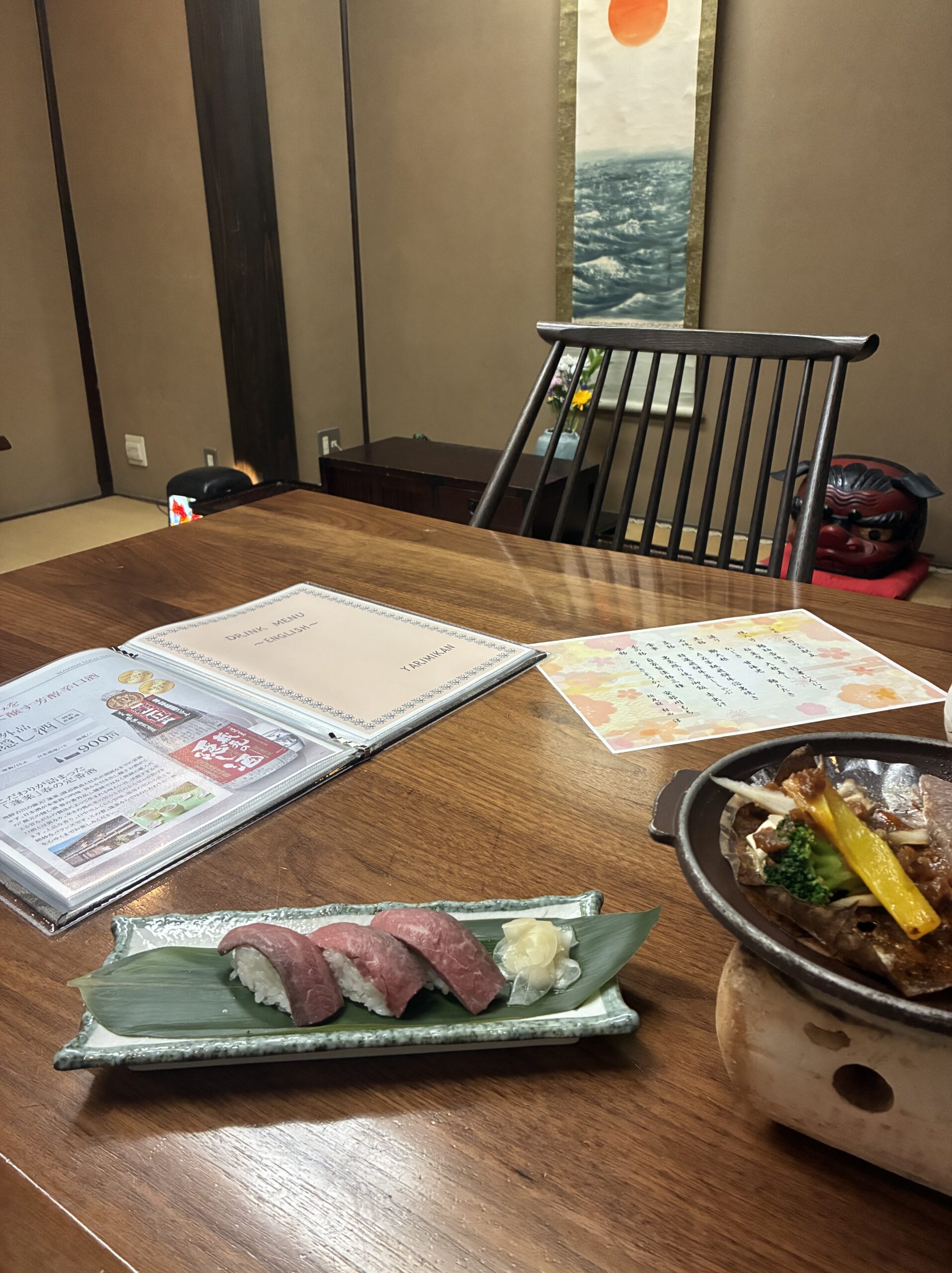
Hida Beef Nigiri — Optional Add-On
For an extra charge — confirm the price when reserving or at check-in — the kitchen will prepare hand-pressed nigiri sushi using Hida beef. The fat content of the beef interacts with the warm rice in a way that is hard to describe; it is rich without being heavy, and worth ordering at least once over the two nights.
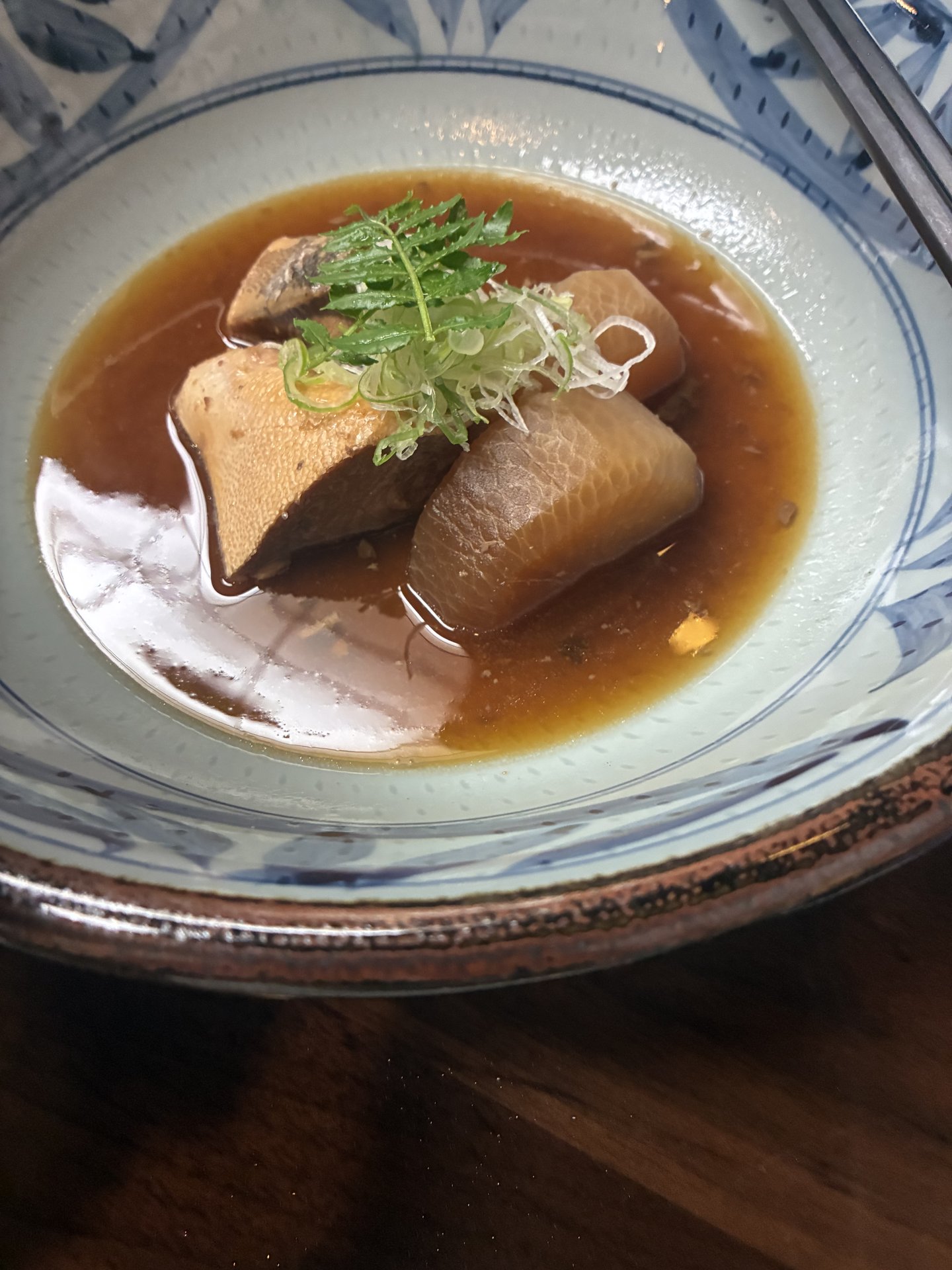
Buri Daikon and the Story of the Buri Highway
The simmered course is buri daikon — yellowtail with daikon radish. The story behind it is part of the appeal: in the Edo period, salt-cured yellowtail was hauled overland from the Toyama coast through Hida to the inland regions, along a route now remembered as the Buri Kaido — the Buri Highway. Chef Murayama is not just plating fish; he is plating a regional trade history that is centuries old.
Aperitif Switch: Karin Wine
Where Night 1 opened with plum wine, Night 2 starts with karin — Japanese quince — wine. The first sip has a faint sparkle, then the quince flavor settles in. It is more aromatic and slightly more complex than the plum wine, and it sets the tone for a more elaborate evening menu.
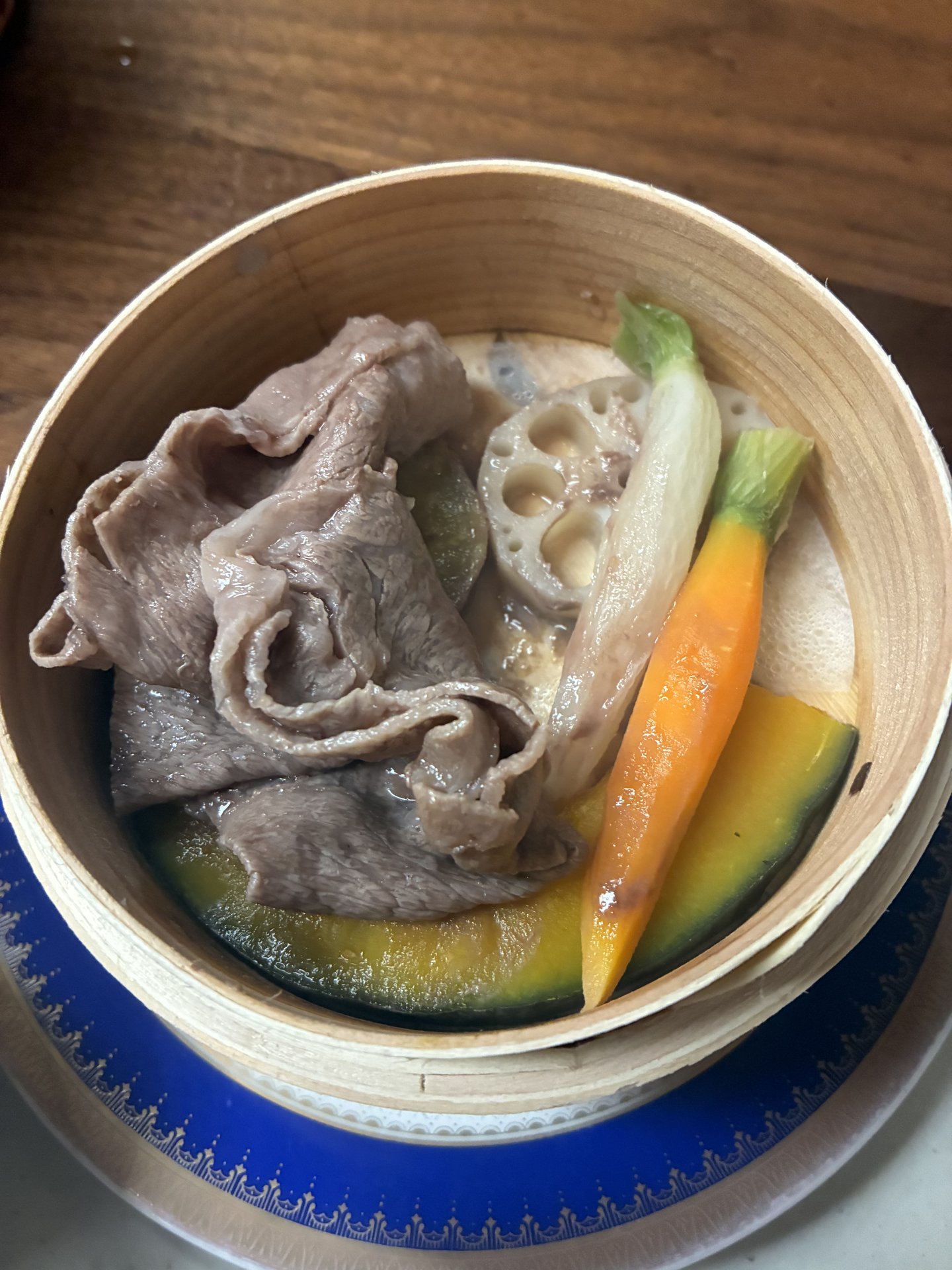
Seiro-Mushi: Steamed Hida Beef and Seasonal Vegetables
A bamboo steamer arrives at the table with thin slices of Hida beef, kabocha squash, lotus root, carrot and leafy greens, all gently steamed. Lighter than the volcanic-stone beef, but built around the same regional ingredient. A different way to read the Hida-beef story across two nights.
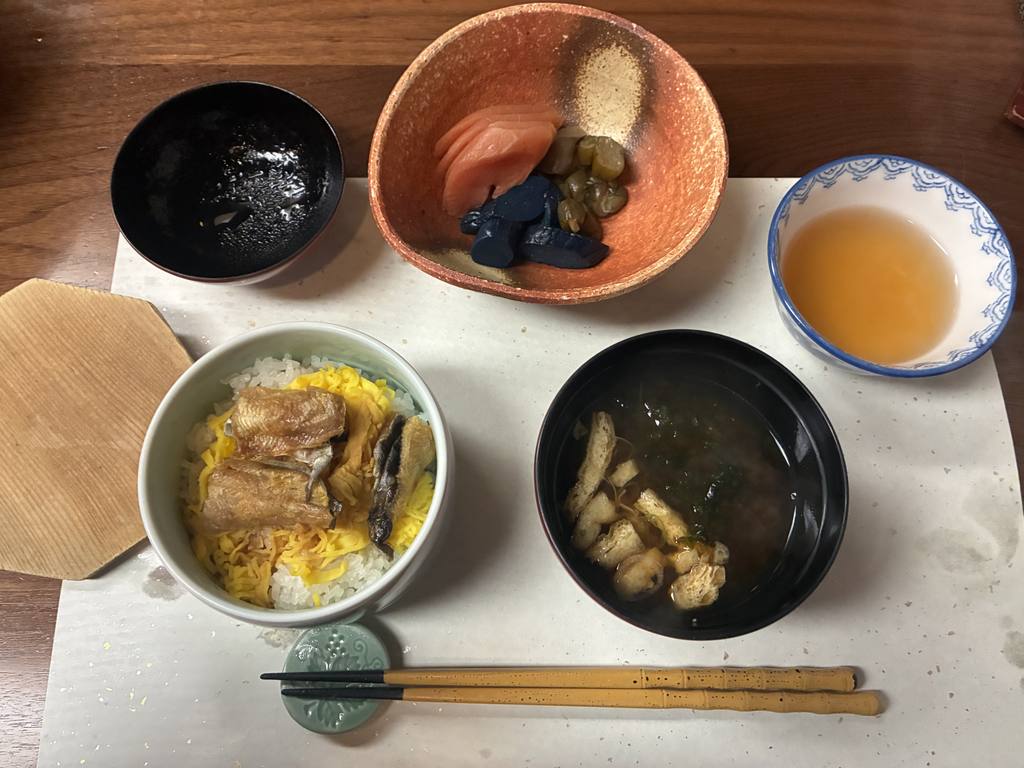
Rice Course Finale: Iwana Teriyaki Donburi
Where Night 1 closed with asari clam takikomi, Night 2 closes with a small donburi — teriyaki-glazed iwana over rice with shredded omelet, paired with a clear soup and a tray of seasonal pickles. A second river-fish appearance after the live sashimi opener: this time cooked, sweet-savoury and quiet.
Breakfast: A Hida-Style Japanese Set With One Bowl of Ramen as Accent
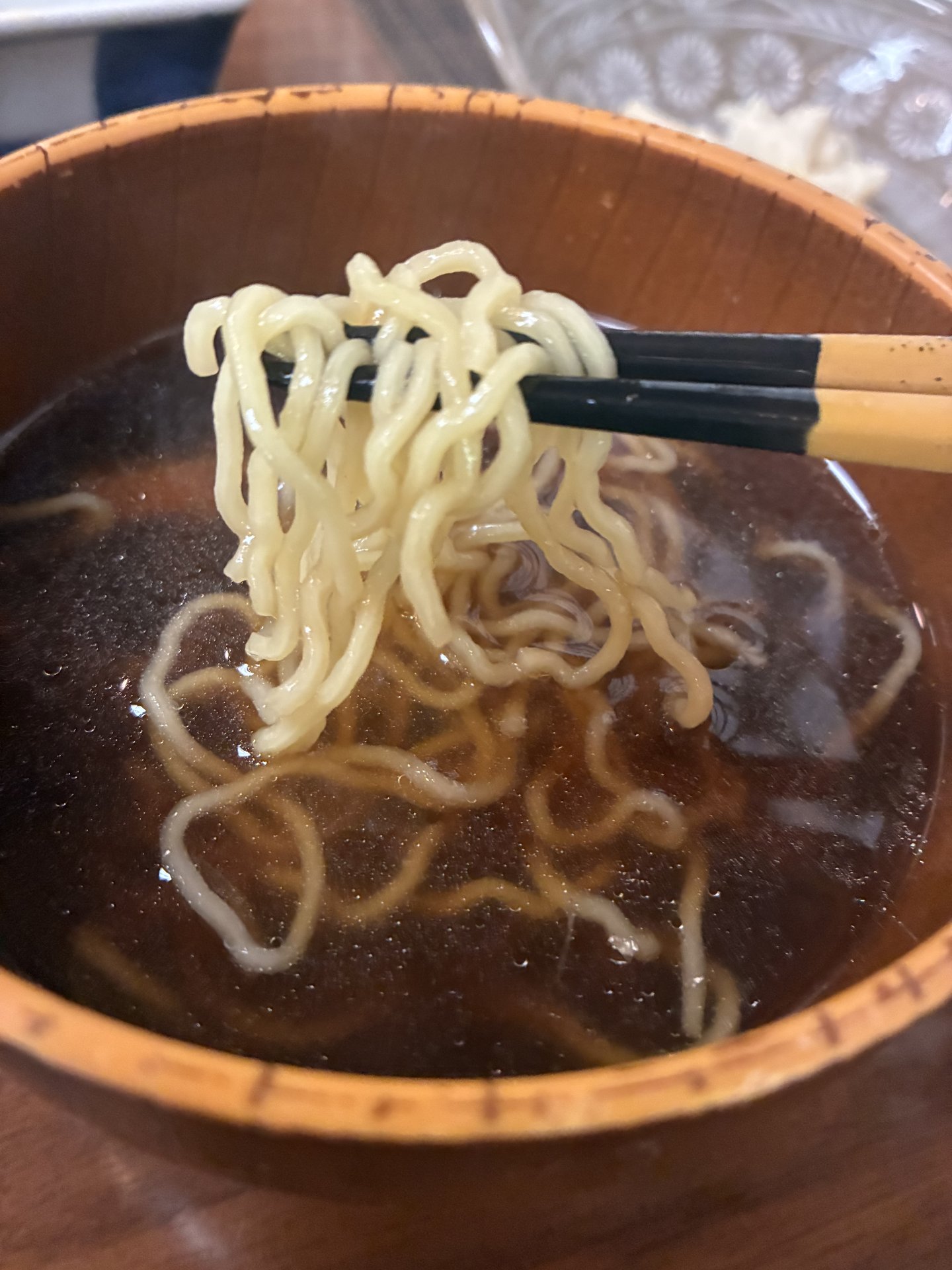
A common misconception about Yarimikan’s breakfast — repeated in some travel blogs — is that “they serve Takayama ramen for breakfast.” That is true, but it is misleading. The main event of breakfast is a full Hida-style Japanese set meal. The ramen is one item among many, served as a small accent bowl. If you arrive expecting a ramen-centric breakfast, you will miss the actual centerpiece.
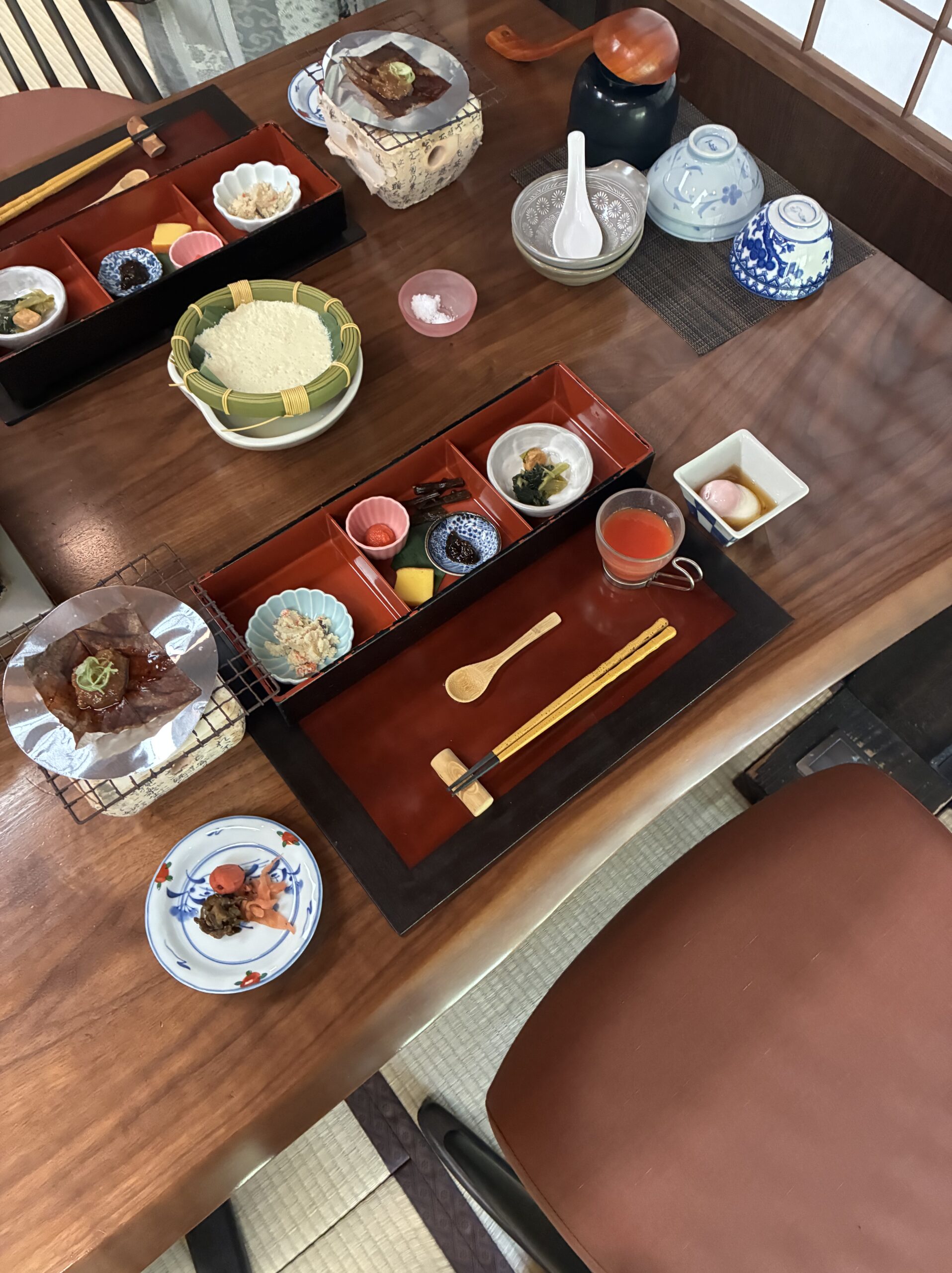
What’s on the Tray
| Item | Description |
|---|---|
| Hoba miso | Sweet miso grilled on a magnolia leaf over a small charcoal grate at your seat. You control the flame. This is the breakfast equivalent of last night’s hoba-yaki. |
| House-made tofu | Served in a green bamboo basket. The texture is what guests remember — soft, almost cloud-like, with a clear soybean sweetness. Nothing like supermarket tofu. |
| Tonjiru — pork miso soup | Replaces the usual breakfast miso soup. Heavier, warming — well-suited to a mountain morning. |
| Eight-compartment jubako | A lacquered box with eight small sides: rolled omelet, ohitashi, umeboshi, tsukudani, pickles, white-dressed vegetables, hot-spring egg, and one rotating item. |
| Tomato juice | A small glass — the Hida region grows excellent tomatoes. |
| Takayama ramen | A small bowl of clear soy-based broth with thin curly noodles. Light enough to eat after the full set. Served every morning, including on consecutive days. |
The portion is calibrated for a body that has just spent the night soaking in onsen — substantial but not heavy. After two nights, my honest summary was: “Both breakfast and dinner are perfectly portioned and delicious.” That sounds like faint praise in English, but in the context of ryokan dining — where over-portioning is a common complaint — it is actually high praise.
If you stay two nights, Day 2 breakfast rotates the main protein — Day 1 may feature one main and Day 2 features a different one. The hoba miso, tofu, jubako, and ramen stay on every day. The rotation keeps consecutive mornings from feeling repetitive.
Optional Day-2 Lunch — Reservation Required
If you are staying two nights, Yarimikan can serve lunch on Day 2 — and reserving when you book is the safest path, because the kitchen needs lead time to prepare the signature lunch dishes. Simpler items may sometimes be possible same-day, but the full experience is best secured in advance. This is one of the most common things international guests miss. If your reservation platform does not have a lunch option in the form, email or call the inn separately to confirm Day-2 lunch.
The signature lunch dish is Tsukemono Steak Hoba-Jitate — a uniquely Okuhida regional dish. Aged white-cabbage pickles are layered with miso and meat, then crowned with a yolk dome and served on a hoba leaf. The recipe was born from a cold-region survival technique: in deep snow seasons, frozen pickles were warmed up to make them edible again. What started as a winter necessity has become a regional specialty.
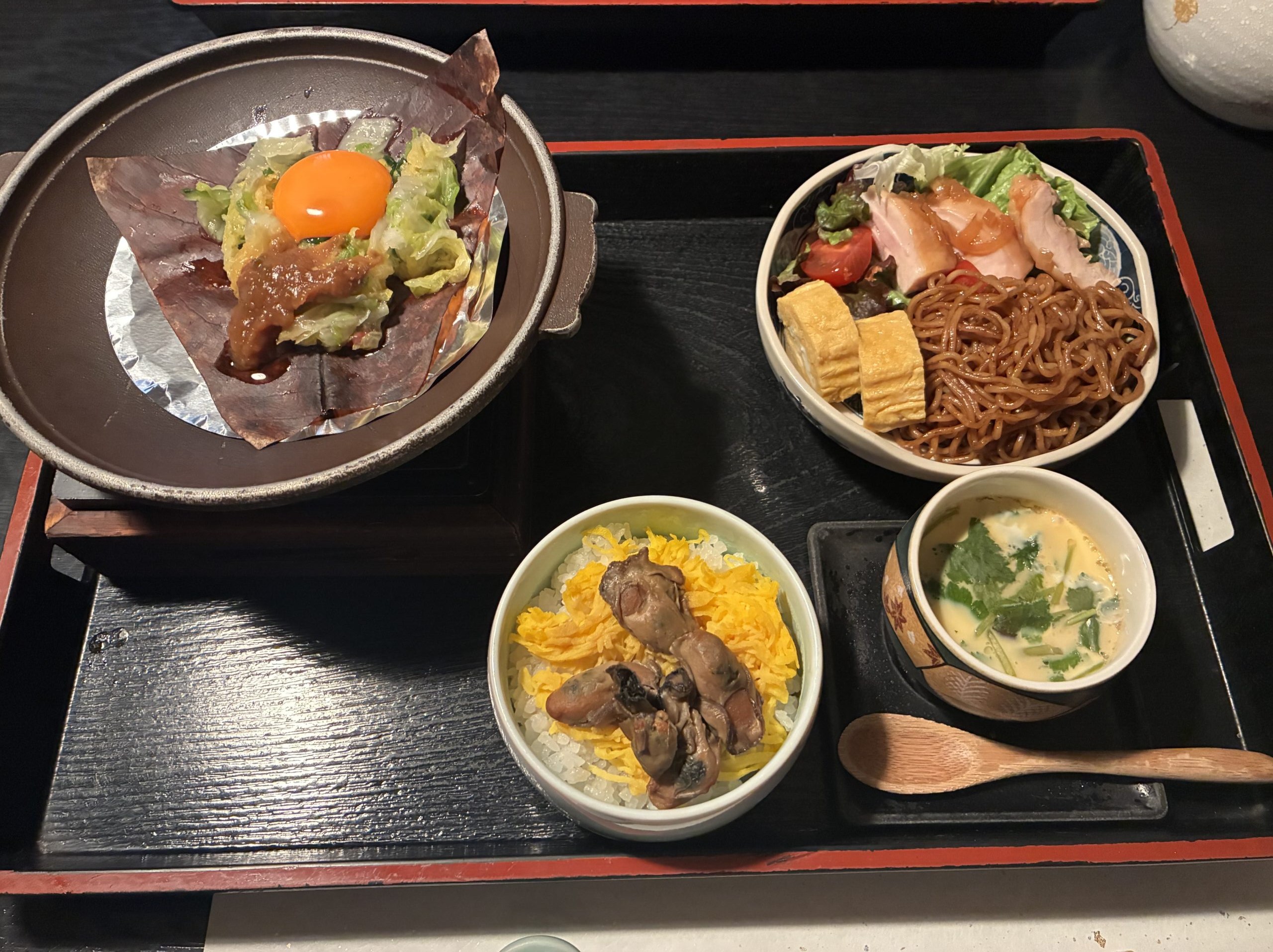
The lunch set also includes oyster rice, chawanmushi savory custard, a small salad, and a mini yakisoba. The dining hall is even quieter at lunch than at dinner, which is part of the appeal — eating in silence with the river audible outside.
Lock in the Day-2 lunch when you book. The signature Tsukemono Steak Hoba-Jitate is rarely available same-day. Use the inn’s English booking page to add the lunch and any allergy notes in one place.
Dietary Notes for International Guests
A few practical notes that will help you plan, especially if you have dietary restrictions:
- Allergies and dietary restrictions: Yarimikan can typically work with common allergies and pescatarian requests if you notify them when reserving. Vegan adjustments are harder because dashi — the foundational stock — uses bonito and kombu. Strict vegan stays are possible but require coordination when reserving.
- Beef-free requests: If you do not eat beef, the kitchen can substitute with additional river-fish or vegetable courses. Notify them well in advance — please confirm the timing with the inn directly.
- Raw fish: If you are uncomfortable with the live iwana presentation on Night 2, tell the inn when you reserve so the kitchen can prepare it cooked from the start. Last-minute requests at check-in may not always be possible.
- Children: Kids’ kaiseki menus are available — quieter portions, no raw fish, and gentler flavors. Confirm when reserving.
- Drink pairings: The aperitifs are non-negotiable parts of the course — plum and karin wine — but you can request non-alcoholic alternatives.
- Mealtimes: Dinner and breakfast are served at set times in the dining hall, communicated to your party at check-in (and reprinted on the welcome card in your room). The schedule isn’t flexible — the kitchen plates each course in synchronized waves across the whole hall, so dishes leave the pass at one moment for everyone. Plan to arrive on time. If you have a tight train or bus connection the next morning, mention it at check-in and ask the front desk to confirm the breakfast slot in advance.
Who Should Visit Yarimikan for the Meals
Yarimikan’s kaiseki is a specific kind of experience — deep regional cooking in a shared dining hall, with two completely different evening menus across two nights, and a few visually intense moments like the live iwana. It is not a fit for every traveler. Here is who I think gets the most out of it.
Perfect for
- Two-night travelers who want a real menu rotation — Night 1 Yoshun and Night 2 with live iwana and A5 Hida beef are entirely separate kaiseki, not a partial swap.
- Hida-region food curious — guests who specifically want hoba-yaki, Hida catfish sashimi, A5 Hida beef on volcanic stone, and the regional Tsukemono Steak Hoba-Jitate at lunch.
- Adventurous diners — comfortable with live sashimi presentation, river fish, and a course pace that takes about 90 minutes per evening.
- Families with school-age children — the kitchen prepares a kids’ kaiseki with no raw fish and gentler flavors when requested at booking.
- Couples who appreciate a quiet shared dining hall — not a private room, but spacious enough that conversations stay in their own pockets.
Not ideal for
- Strict vegans without advance coordination — the dashi base uses bonito and kombu, so vegan stays are possible but require email or phone discussion well before arrival.
- Travelers expecting a private dining room — meals are served in the shared dining hall, not in your guest room.
- Guests who find live sashimi distressing — the iwana on Night 2 is presented while still moving. Tell the inn when you reserve so the kitchen can prepare it cooked from the start, since it is the signature presentation by default.
- One-night stays hoping for the full menu range — the Day-2 lunch with Tsukemono Steak Hoba-Jitate and the Night 2 menu both require the second night.
My Honest Take
Two nights at Yarimikan covered five distinct meals — Night 1 dinner, Day 2 breakfast, Day 2 lunch, Day 2 dinner, and Day 3 breakfast. The summary I keep coming back to is: portion control is exactly right, and the regional identity comes through clearly.
What I appreciated most:
- The two-night menu rotation is real, not cosmetic. Night 2 is a different course in every category.
- The breakfast set leans into Hida tradition rather than chasing trendy “ryokan breakfast” formulas. Hoba miso, fresh tofu, jubako, tonjiru — this is what a mountain Japanese breakfast actually looks like.
- Chef Murayama’s calligraphic place mats and the buri kaido story are not gimmicks. They are part of how the kitchen frames the food.
Note: This article is written and translated with the assistance of AI, based on the author’s first-hand travel experience and photographs. Please let us know if you spot any errors.
About the Author
Hi, I am MATSUI. I am a Japanese onsen lover who has stayed at more than 50 ryokans across Japan over the past several years. I started onsen-japan.com to share an honest, locally-rooted view of Japanese hot-spring culture, especially for international guests planning their first ryokan stay.
Yarimikan’s kaiseki and the chef’s “mizu no saezuri” framing stayed with me long after the visit. If you have any questions about the meals, the Day-2 lunch reservation, or whether the live iwana presentation will suit you, please leave a comment. I read each one.
Related guides in this Yarimikan series
More from the Yarimikan stay series: