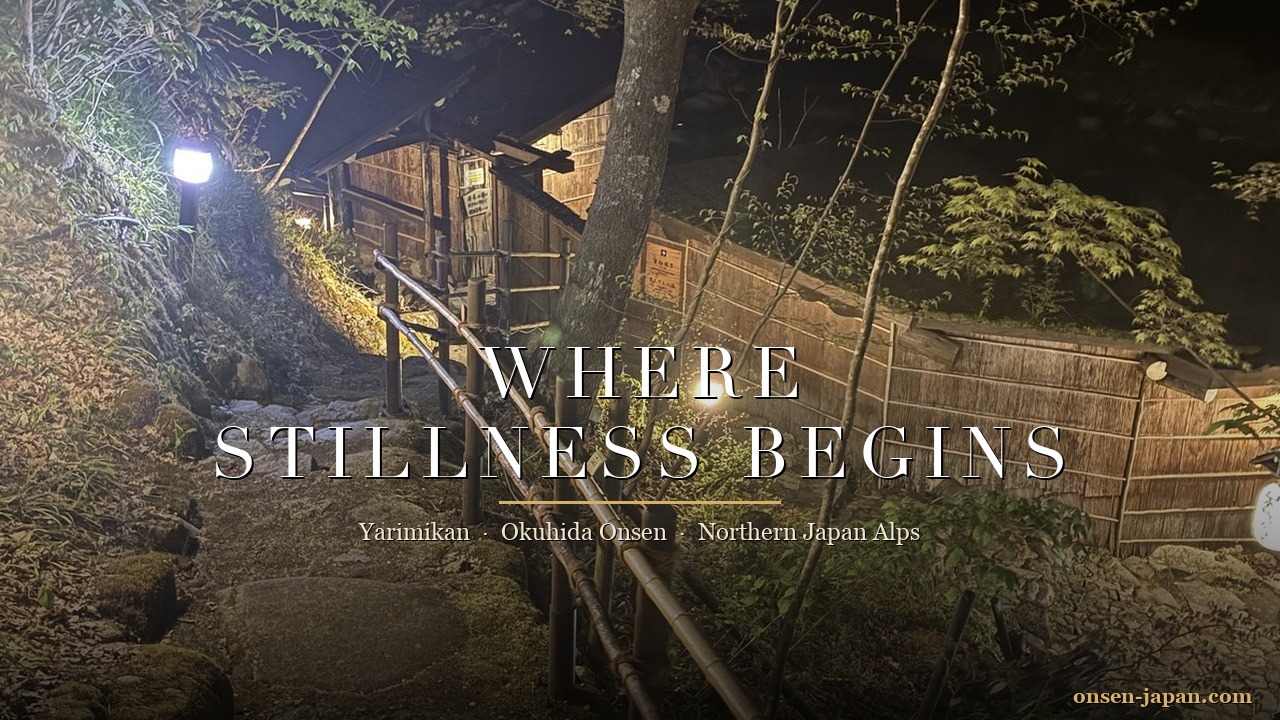
In this article you will discover
- The story of Yarimikan, a centuries-old hidden ryokan deep in the Okuhida Onsen Village
- How the ten onsen baths and the wooden-tag private bath system actually work
- What an evening in an irori room with yukata feels like, hour by hour
- Two completely different kaiseki dinners and the morning mochi-pounding ritual
- Honest notes on who this ryokan suits and who may want to choose elsewhere
Last visited: late April 2026. Hi, I am MATSUI — a Japanese onsen lover who has stayed at more than 50 ryokans across Japan and visits a new hot-spring town roughly every two months. This is my honest two-night review of Yarimikan, a hidden ryokan tucked deep into the Northern Japan Alps.
What you’ll find in this guide
- The full picture of an old-house-style hidden ryokan in a Northern Alps gorge, looking up at Mount Yari and the Hotaka range
- Ten baths, open 24 hours: 4 private outdoor baths, 2 mixed outdoor baths, 1 women-only outdoor bath, 1 lounge by the river, and 2 indoor baths
- Rooms with a built-in irori: tatami space where Japan reaches you through every sense
- Why two nights makes the inn open up, plus the head chef’s poem-driven kaiseki
- How easy it is for international guests — English-speaking staff, trilingual signs, and access from Tokyo, Osaka, Kyoto, and Nagoya
Where Is Yarimikan?
Yarimikan sits in Shinhotaka Onsen, the deepest of the five hot-spring villages that make up Okuhida Onsen-go in Gifu Prefecture. From Takayama, you follow the highway up the Kamata River. The valley narrows. Even into May, snow lingers on the peaks above. Spring brings cherry blossoms along the road. Summer is fresh green. Autumn turns the maples. Winter is deep snow. The same valley, four very different faces.
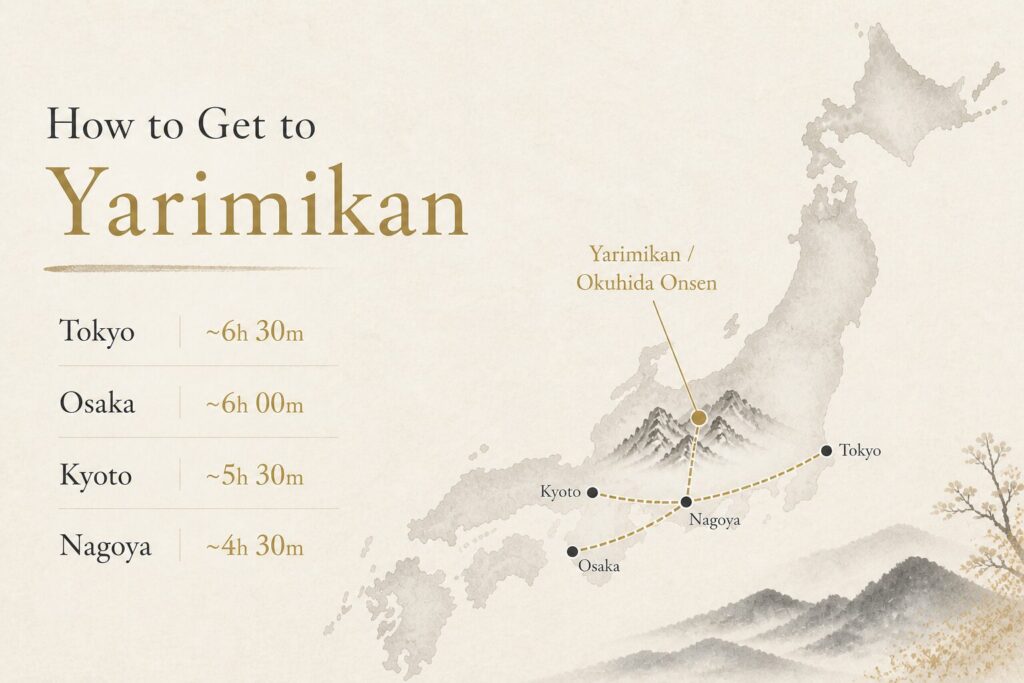
Distance from Japan’s Major Cities
| From | Recommended route | Total time |
|---|---|---|
| Tokyo | Shinkansen via Nagoya → Limited Express Hida → Nohi Bus → 9 min walk | ~6h 16m ¥18,680 / 583 km / 2 transfers |
| Osaka | JR from Shin-Osaka → Shinkansen via Nagoya → Hida → Nohi Bus → 9 min walk | ~5h 45m ¥14,500 / 408 km / 3 transfers |
| Kyoto | Shinkansen via Nagoya → Hida → Nohi Bus → 9 min walk | ~5h 10m ¥13,840 / 365 km / 2 transfers |
| Nagoya | Hida → Nohi Bus → 9 min walk | ~4h 28m ¥8,260 / 218 km / 1 transfer — fastest route |
From Takayama Station, the Nohi Bus on the Shinhotaka line takes about 1 hour 30 minutes to Nakao Kogen-guchi stop. The ryokan is a short walk from there. Detailed access info — JR Pass coverage, Nohi Bus timetables, rental car routes, highway buses — is in the practical information section below.
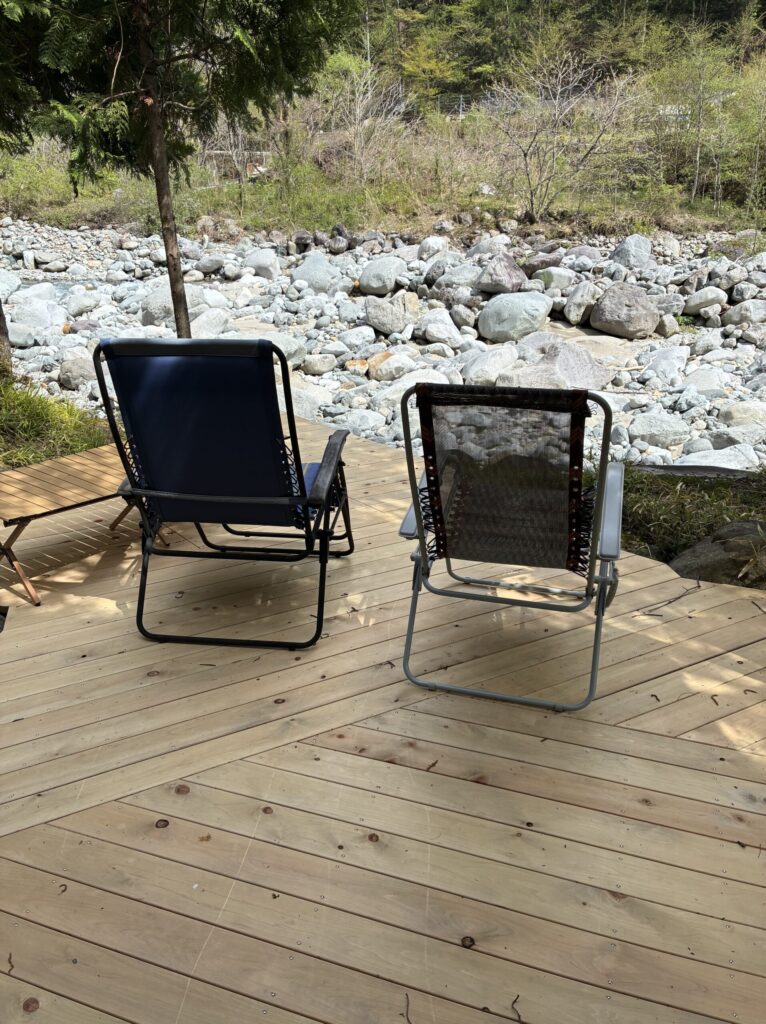
One reason to choose this location is the river. Spring snowmelt makes the Kamata roar more loudly than at any other time of year. Open the window after check-in, and the river is everything. The phrase Yarimikan uses on its menus and decor — “mizu no saezuri” — the chirping of water — captures the place better than any tourism slogan could.
📖 More on the area, the Shinhotaka Ropeway, and what to do nearby: Spoke article — Yarimikan Things-to-Do Guide coming soon
The Onsen: 10 Baths, 4 Private, Open 24 Hours
This is the heart of Yarimikan.
The inn has ten different baths, arranged with the outdoor ones along the riverbank and the indoor ones in the main building — an unusual layout even by Japanese ryokan standards.
| Bath | Type | Notes |
|---|---|---|
| Yarimi-no-yu | Mixed outdoor | Panoramic view toward Mount Yari. Women-only 7–9 a.m. |
| Manten-no-yu | Mixed outdoor | Spacious, often empty. Lights dim automatically at night |
| Iwami-no-yu | Women-only outdoor | Natural stone, calm atmosphere |
| Hotaru-no-yu | Private outdoor | Stone-lined, sheltered, my personal favorite |
| Keiryū-no-yu | Private outdoor | Closest to the river — the best view, with a roof |
| Mori-no-yu | Private outdoor | A swing, a percussion bath, and a small basin — family-friendly |
| Banryū-no-yu | Private outdoor | Hand-cut stone, generously sized |
| Nagomi-no-yu | Lounge | A river-view room with chairs — not a foot bath |
| Gote-no-yu | Indoor — men | With wash stations |
| Kaka-no-yu | Indoor — women | With wash stations |
The outdoor and private baths are open 24 hours — cleaning windows aside. The indoor baths run from check-in until 10 a.m. the next morning. Soaking alone in an outdoor bath at midnight, with no one else around, is a privilege you don’t get at most ryokans.
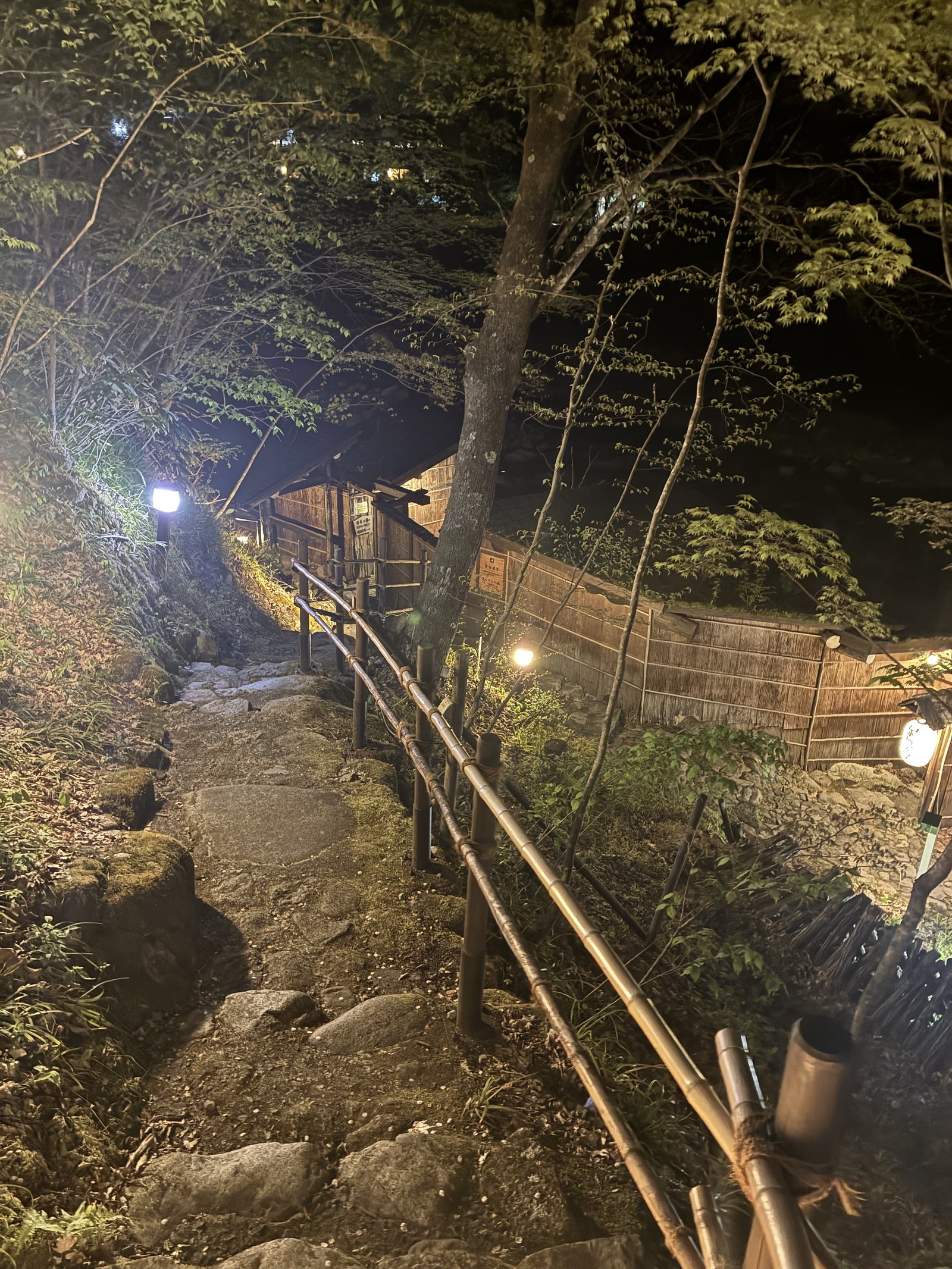
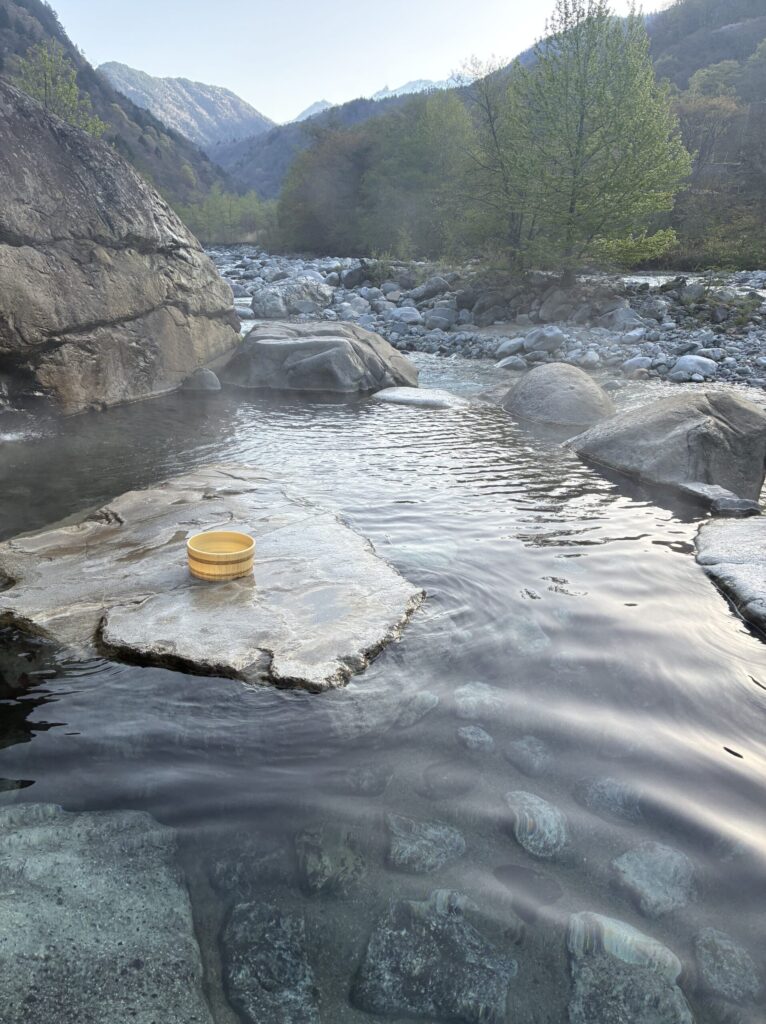
The Four Private Baths Are the Real Highlight
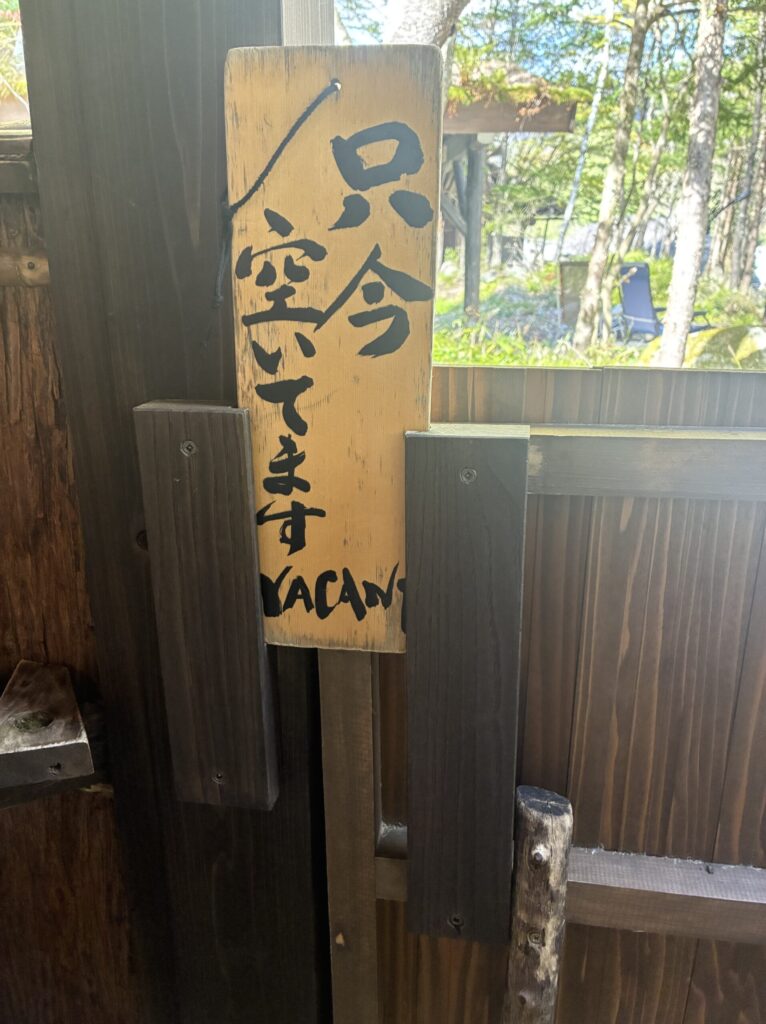
For overnight guests, the four private outdoor baths are free, on a first-come basis, with a wooden-tag system. There’s no time limit — as long as you’re inside, the bath is yours.
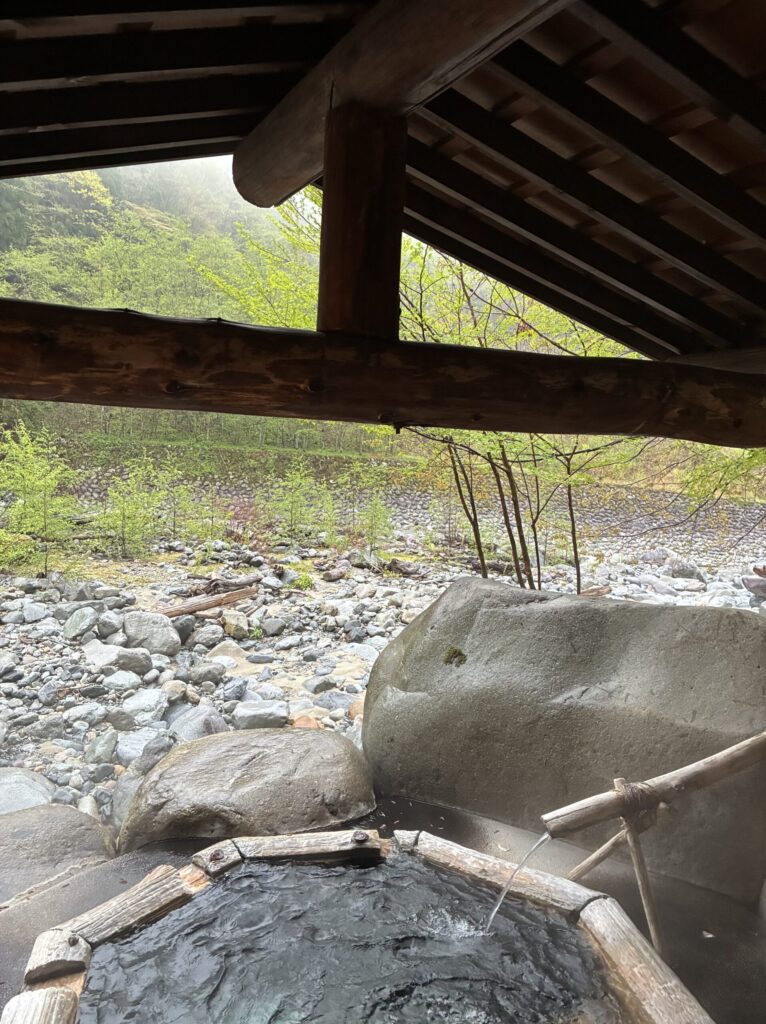
The most striking is Keiryū-no-yu — “the river bath”, where the Kamata roars two meters from the tub. I went back to that one over and over.
The water itself is gentle on the skin — softer than the typical sulfuric or iron-heavy onsen. What makes the experience overwhelming is the river noise. Stepping into the bath at night for the first time, the honest thought I had was: “the water is gentle, but the river is enormous.” Both arrive at the same time, and that combination is what makes Yarimikan feel like Yarimikan.
Tattoo Policy
Over two days, I checked all ten changing rooms. There were no “no tattoos” signs anywhere. Small to medium tattoos appear to be welcome without comment. Anyone with larger tattoos can simply use the four private baths, which give you a fully private space.
Practical Notes for the Bath Areas
- Bathing wear — yuami-gi — is provided. Women’s is in the room. men’s is loaned at the front desk. Men can also bathe nude if they prefer. This makes the mixed baths much easier for guests new to onsen culture.
- Use the indoor baths at night. The stone steps to the outdoor baths get slippery in the rain or dew. The indoor baths also have wash stations.
- Two routes to the outdoor area. The shortcut from the rooms is steep and gravel. the route via the indoor baths is paved. Use the paved route in rain or at night.
- Umbrellas are loaned out. All four private baths have roofs, so even in rain you can move between them comfortably.
📖 The full bath-by-bath breakdown — water composition, late-night strategy, how to use the wooden-tag system: Spoke article — Yarimikan Onsen Complete Guide coming soon
The Room: Irori, Yukata, and the Quilted Dotera
Yarimikan offers four broad room types.
| Type | Character | Approx. price — 1 night, 2 meals, per person |
|---|---|---|
| Wa-modern | Japanese-modern fusion, more contemporary lines | From ¥21,250 |
| Mingei — folk-style | Heavy beams, old-house feel. Some rooms include a built-in irori | From ¥21,250 |
| Wa-yo with private indoor bath — barrier-free | Tatami + bedroom, hinoki indoor tub, handrails. Only 1 room | From ¥24,550 |
| Storehouse-style detached suites | Two-story, private outdoor bath, family-sized — 5–6 people. Two suites: “Kiri” and “Kasumi” | From ¥30,050 |
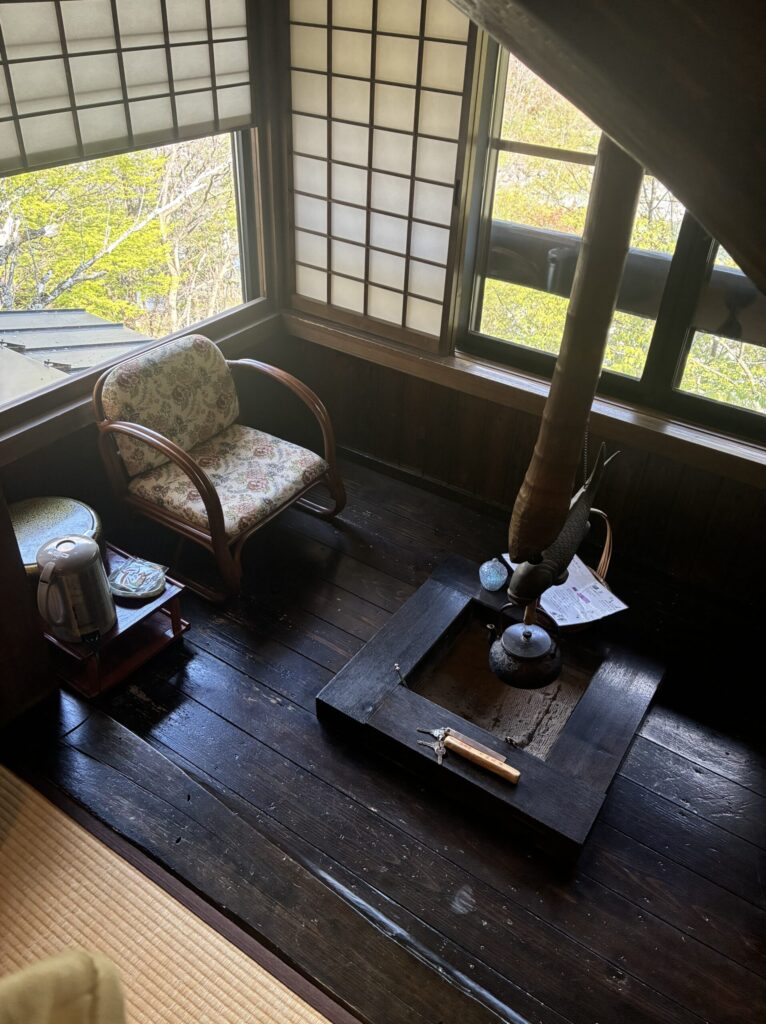
I stayed in a mingei-style 8-tatami room with an irori. Two futons fit comfortably with room to spare, and a low table sits beside a window seat looking down at the river. The size suits couples and solo travelers — not a big group room.
Families should look at the detached suites — “Kiri” and “Kasumi”. They’re maisonette-style, sleep up to 5–6, and have their own private outdoor bath. I saw several families with kids around the inn during my stay.
The biggest surprise was the irori in the room itself. Lobbies and shared spaces with sunken hearths are common in Japanese inns. finding one built into a guest room is rare. Guests can light the charcoal themselves. The moment you walk in, the room smells faintly of old smoke and cedar, and the air feels different.
What’s Inside the Room
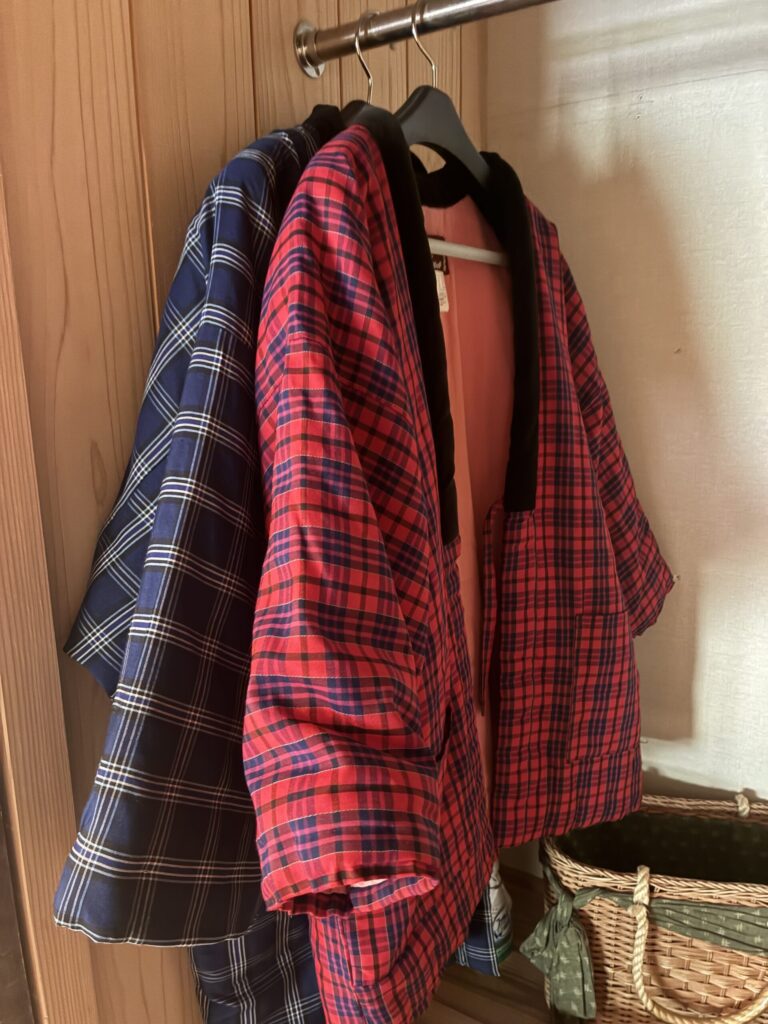
- Yukata — red checked pattern in our case — patterns vary
- Dotera — a padded over-robe, folded by the door. Putting it on the cool morning was the moment I felt actually wrapped up
- Yuami-gi — bathing wear: women’s in the room, and men’s at the front desk. men can also bathe nude
- Towels, toothbrushes, basic skincare — POLA amenities
- Western toilet
- Writing desk and low table
- Wi-Fi reaches the room — speed is fine, not fast
Quiet Touches Throughout
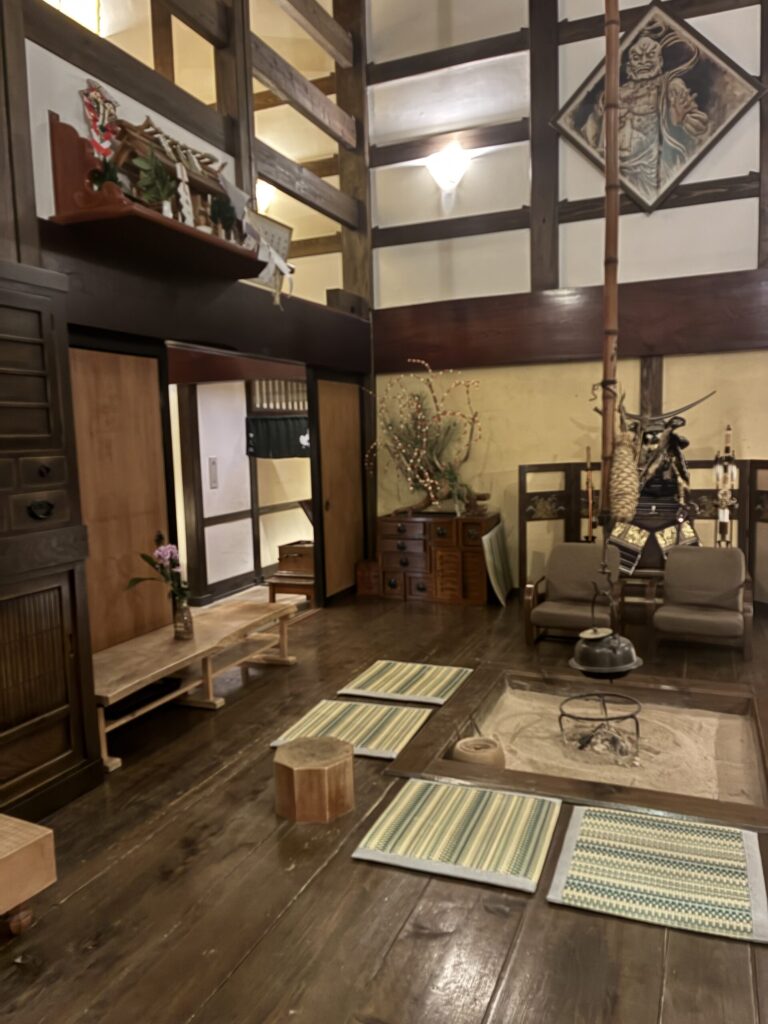
A vase of plum blossoms beside a samurai armor in the lobby. Hand-painted washi paper on the corridor lanterns. The dinner placemats carry the chef’s calligraphy. On a two-night stay, a member of staff drops by around 2 p.m. on the second day to ask if you’d like the room cleaned.
📖 Full breakdown of the irori rooms, the yukata and dotera, and tips for back-to-back nights: Spoke article — Yarimikan Room and Irori Guide coming soon
The Food: A Kaiseki That Begins with a Poem
If the onsen is the heart of Yarimikan, the food is the soul. Multi-night stays include breakfast, lunch, and dinner. The remarkable thing is that the dinner menu changes completely on the second night. Many ryokans repeat most dishes across consecutive nights, swapping out one or two. Yarimikan changes everything.
Night One: The Yoshun Course
The first dinner is themed around Yoshun — “bright spring”. When you sit down, the chef’s calligraphy is already on the placemat:
“Listening to the chirping of water, I drape myself in the moving colors of the mountain.”
That isn’t just decoration. It’s the structural axis of the meal — the colors of spring layered over the contrast between river and mountain, plate by plate.
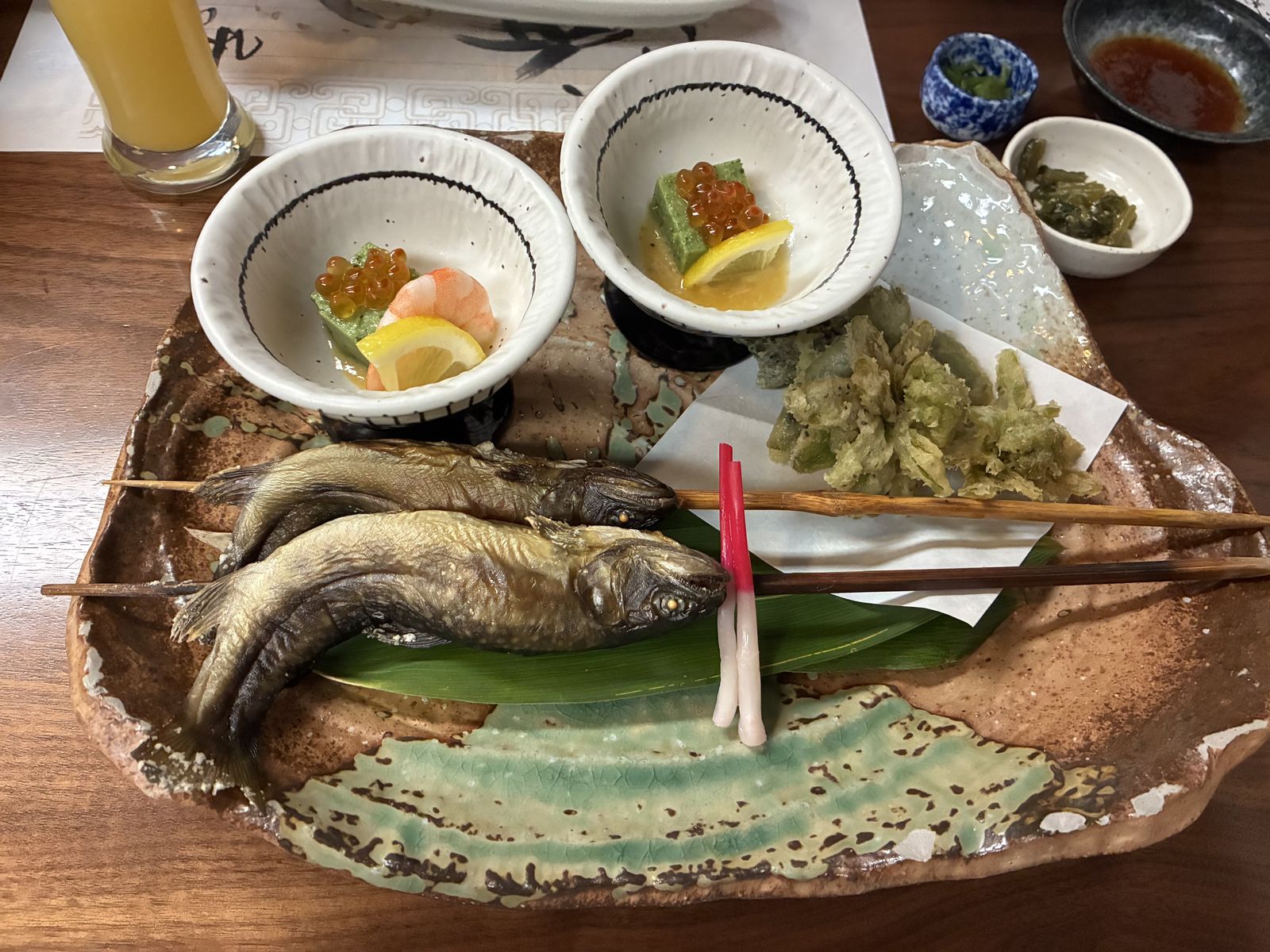
The most memorable dishes from the first dinner:
- Sashimi assortment, including Hida catfish. Okuhida is known for freshwater fish farming, and Hida catfish has none of the muddiness you’d expect — clean, light, white-fleshed. Catfish sashimi at a ryokan is unusual. Alongside: Hida salmon, A5 Hida-beef roast beef, and prawn.
- Shunryō-mushi — “spring-green steamer”. Tilegrouper paired with bamboo shoot and scallop in a steamer — the “color of spring” line from the chef’s poem made literal.
- Whole grilled Hida ayu — sweetfish.
- Hida-beef hoba-miso yaki — beef and miso grilled at the table on a magnolia leaf.
- Asari rice and clear soup to close.
Night Two: A Completely Different Menu
I did not expect this. Not a single dish from night one repeats on night two. Even the welcome drink changes — umeshu, plum liqueur, on the first evening, and karinshu, a Japanese quince liqueur, on the second. A brief sparkle of fuwa-shuwan effervescence on the tongue, then the quiet, woody warmth of quince settles in. This kind of detail is the ryokan quietly betting on itself.
- Live-cut iwana — a presentation you only see at mountain inns.
- Buri-daikon. A dish with deep history: salt-cured yellowtail from Toyama Bay used to be carried over the Buri Highway through these mountains in the Edo era, becoming a winter staple in snowbound Hida and Shinano.
- A5 Hida-beef on a hot lava stone. The texture comes down to one word: it melts.
- Hida-beef nigiri sushi — an extra add-on. No soy sauce needed — the beef alone is sweet enough.
- Iwana teriyaki rice to close.
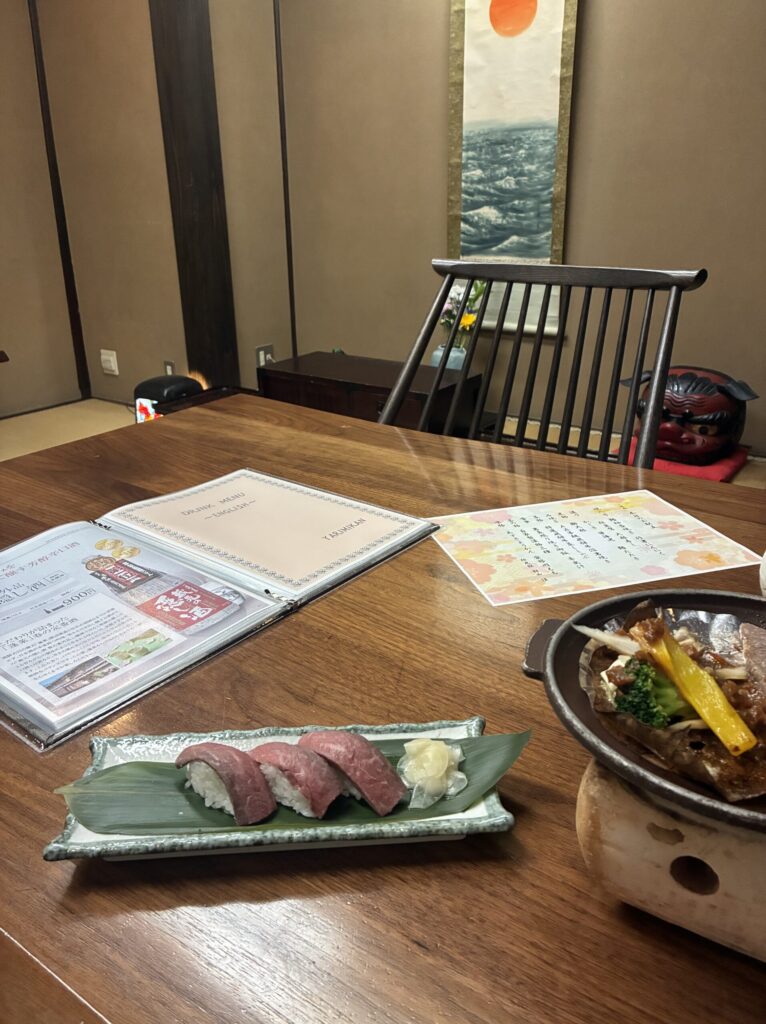
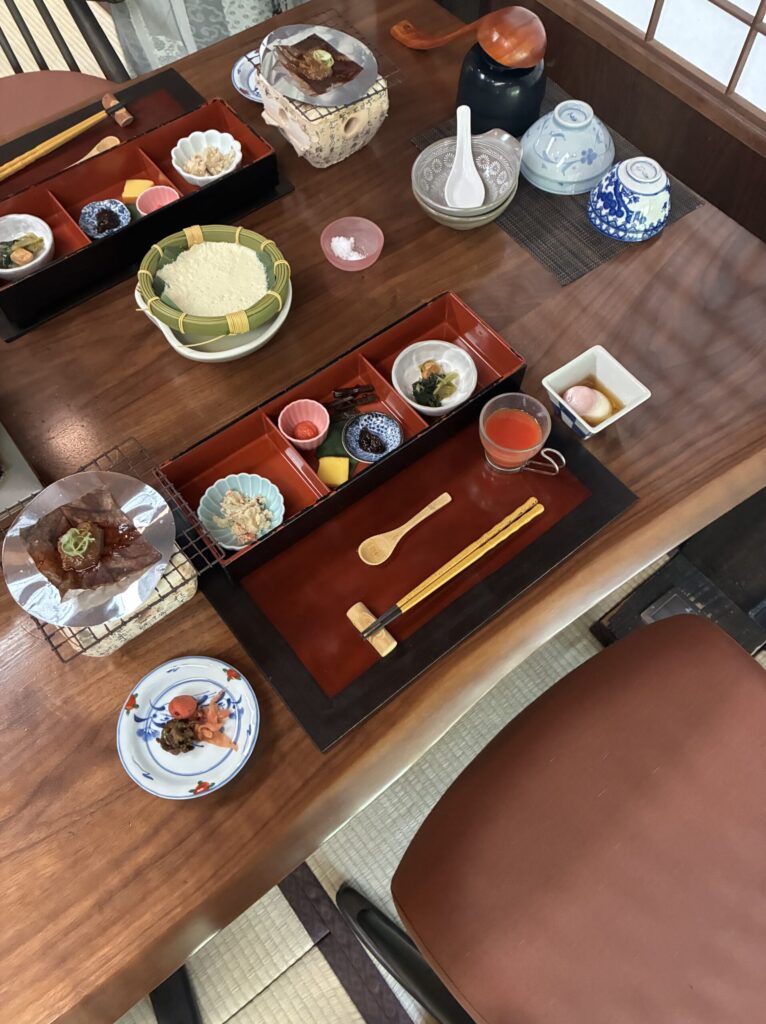
Breakfast: Japanese Set as the Main, Ramen as an Accent
If you’ve heard about ramen at breakfast in this region and were unsure what to expect — here’s the honest answer. The Japanese set is the main event — charcoal-grilled hoba miso, eight side dishes in a lacquered box, homemade tofu, pork miso soup. The Takayama-style ramen is served as a small accent — less than half a normal portion — and lands well at that size.
- Hoba miso — miso grilled on a magnolia leaf over charcoal at the table
- Takayama ramen — small bowl, soy-based, plays the supporting role
- Pork miso soup
- Homemade tofu served in a green bamboo basket — light, with a “fuwa-shuwan” mouthfeel
- Eight small dishes in a vermilion lacquered box — rolled egg, pickles, simmered vegetables, plum, salt-cured fish, natto, onsen egg, etc.
- Tomato juice
On the second morning, the breakfast adds grilled salmon, a small four-compartment plate, and a fruit jelly. Everything else carries over.
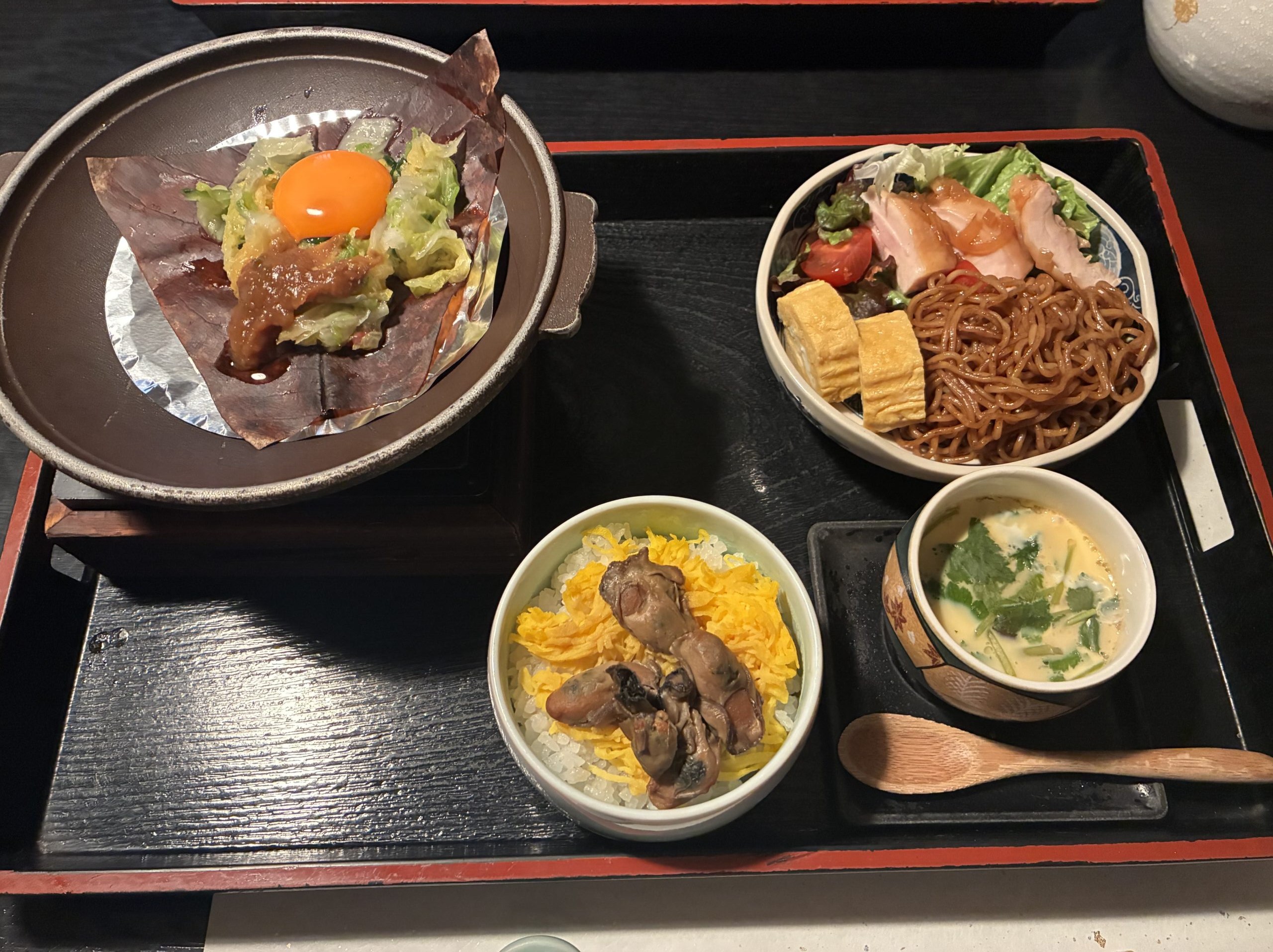
Lunch — Reservation Required: An Unexpected Bonus
On the second day, you can take lunch in the inn between baths — but only if you reserve in advance — when reserving or at check-in. same-day requests are not accepted.
The signature lunch dish is tsukemono steak — pickled napa cabbage, miso, pork, and an egg yolk grilled together on a magnolia leaf. The legend is that during Okuhida’s long winters, locals would warm their frozen pickle barrels rather than eat them cold. what started as survival cooking turned into the region’s calling card. You break the yolk yourself and mix everything as you go.
The lunch menu also included kaki-meshi — oyster rice, which is a small surprise this far inland — a quiet reminder that Hida’s food culture casts a wider net than you’d guess.
The lunch room was nearly empty. Quiet adds flavor, I thought.
A Small Bonus: Morning Mochi Pounding
At 9 a.m. each morning, a wooden mortar and mallet are set up in the lobby, and you can pound mochi together with the staff.
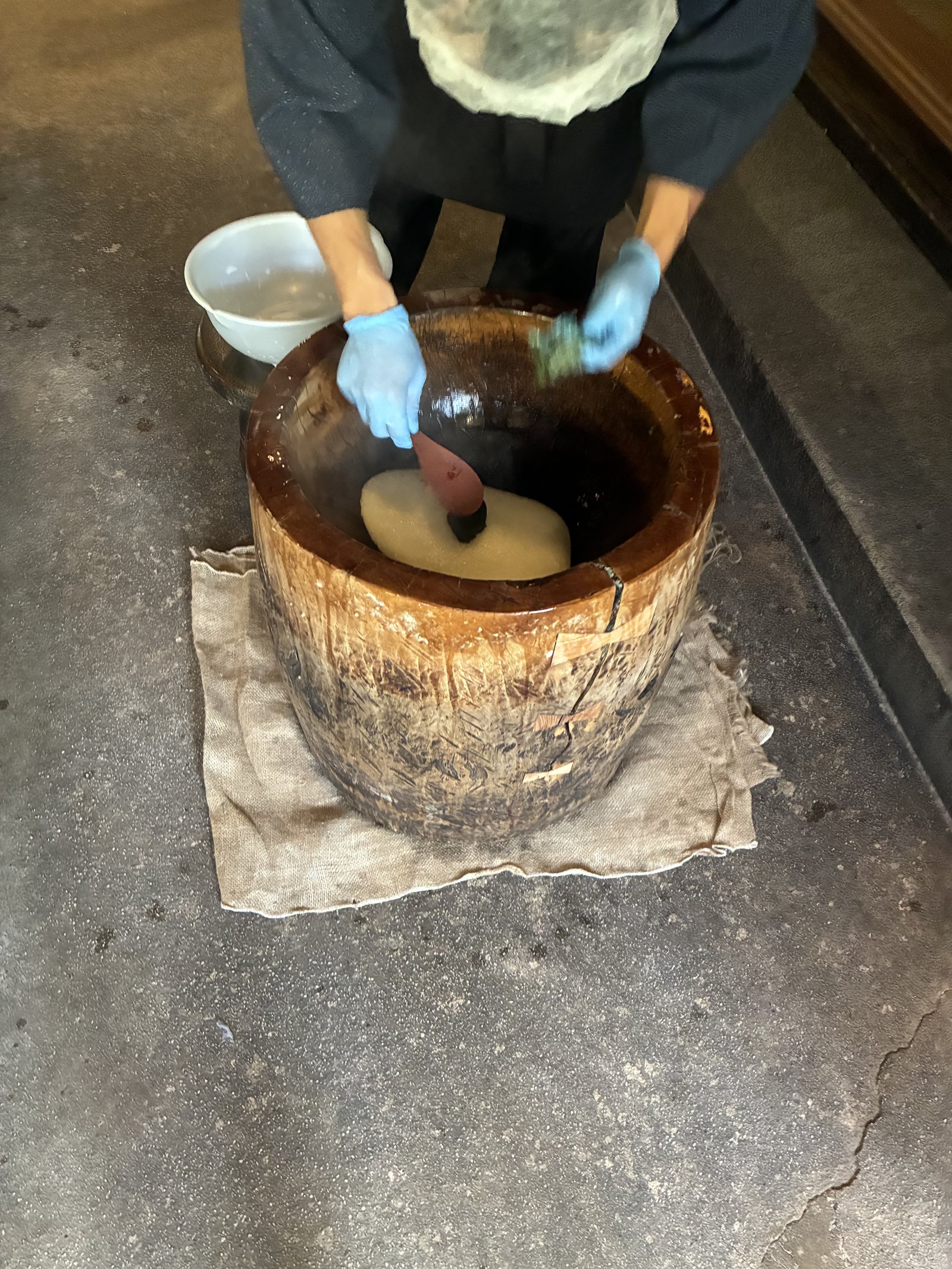
The freshly pounded mochi is topped with yomogi-an — mugwort and sweet red bean paste and served on a small vermilion plate. Mugwort is one of the first plants to push through the snowmelt here in spring — so it threads neatly back into the chef’s “spring green” theme.
📖 The full kaiseki breakdown — Yoshun course dishes, the second-night menu, breakfast structure, how to reserve lunch: Spoke article — Yarimikan Food Complete Guide coming soon
For International Guests: Easier Than You’d Expect
This is worth flagging up front.
Multiple staff members speak English. Our check-in was handled by an international staff member with native-level English. During the stay I saw several non-Japanese staff — appearing to be from Asia and the Middle East, all switching naturally between Japanese and English. For a ryokan this deep into Okuhida, that level of language coverage is genuinely unusual.
Signage is trilingual. Around the private bath area, signs read Mori Bath · 包雷浴池 · 森の湯 — Japanese, English, and Simplified Chinese. The same applies to mixed-bath versus private-bath markings. You don’t need a translation app to navigate.
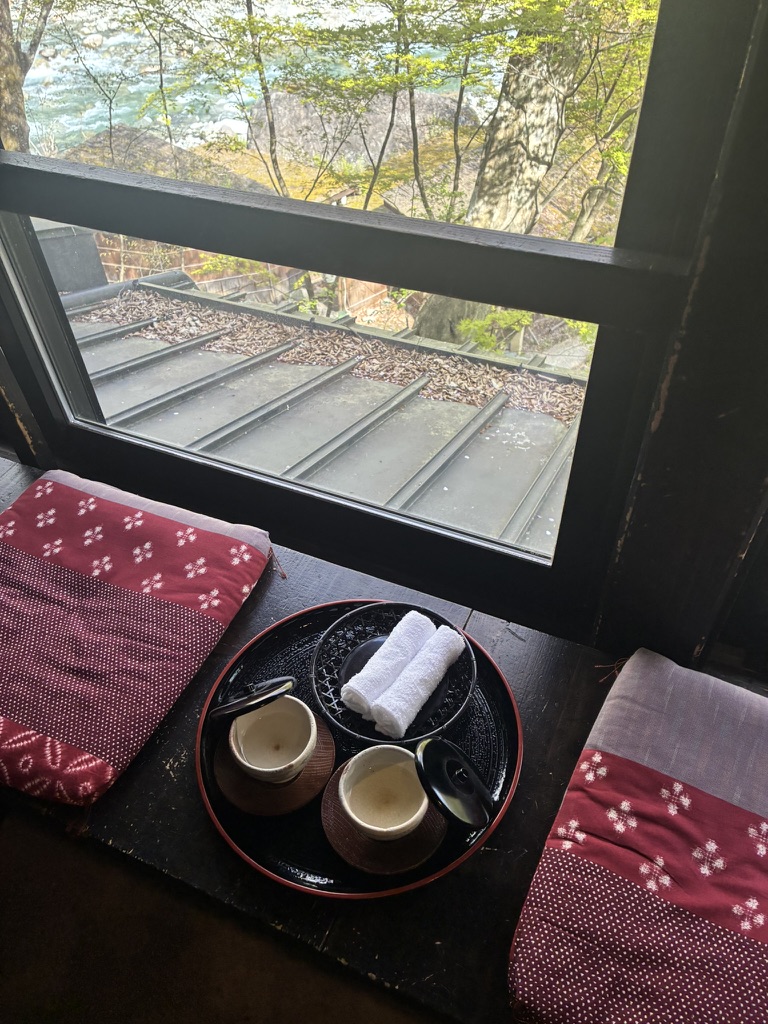
Welcome tea on arrival. A small cup of plum-kelp tea — umekobucha is brought to you in the lobby. It isn’t a big show of hospitality — it’s more like a gentle signal: let the trip end and the stay begin.
If this is your first ryokan, the language barrier here is much lower than you might expect.
Who Should Visit Yarimikan?
Yarimikan is a strong fit for:
- Couples and solo travelers seeking a quiet, undecorated onsen experience far from the crowds.
- Onsen lovers who want to soak in ten different baths within 24 hours, each with its own character.
- Travelers who do not mind a long detour. Okuhida is genuinely remote, and that remoteness is the point.
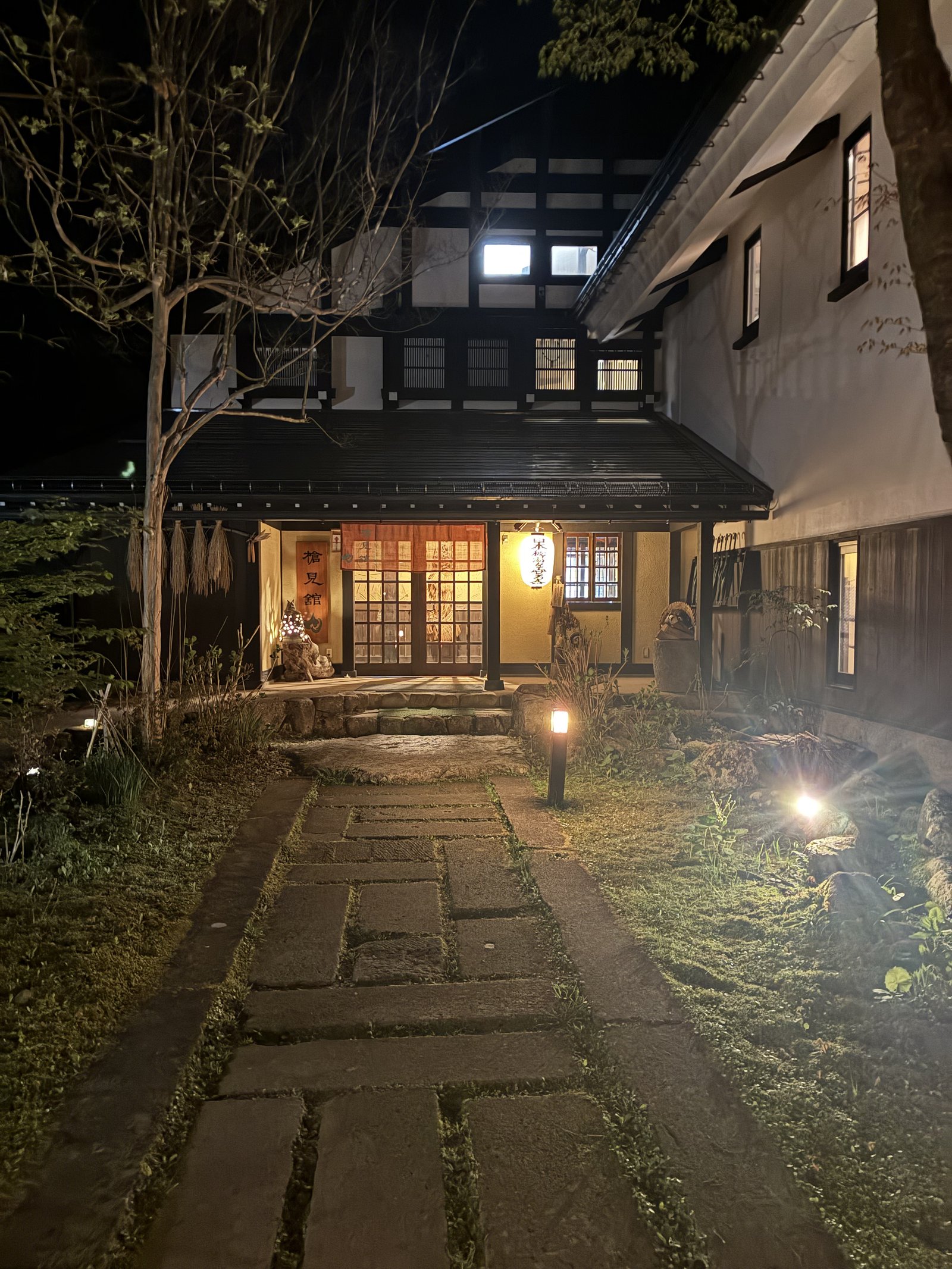
- Photographers and quiet thinkers who appreciate timber, charcoal smoke, and stone paths lit by lanterns.
Less ideal for:
- First-time onsen visitors who need English-speaking staff at every turn. Some staff speak basic English, but most printed information is Japanese only.
- Wheelchair users, due to steep stone paths to the outdoor baths and traditional wooden floors. Please call ahead to confirm what is feasible.
- Travelers who need fast, modern hotel service. Yarimikan’s pace is deliberately slow, and that stillness is the experience itself.
- Families with very young children. Corridors are narrow and old wooden floors creak. School-age children and older are usually fine.
Practical Information
| Address | Kamisaka, Okuhida Onsen-go, Takayama City, Gifu — Shinhotaka Onsen |
| Best for | Couples, solo travelers, two-night stays. Families for the detached suites |
| Less suitable for | Tight schedules, one-night stays trying to cover everything |
| Room types | Wa-modern / mingei — some with irori / wa-yo with private indoor bath — barrier-free, 1 room / detached storehouse suites with private outdoor bath — 2 suites, 5–6 people |
| Baths | 10 total — 4 private outdoor / 2 mixed outdoor / 1 women-only outdoor / 1 lounge / 2 indoor |
| Bath hours | Outdoor & private: 24h — cleaning aside. Indoor: check-in to 10 a.m. |
| Tattoo policy | No “no tattoo” signage at any of the 10 baths — as of April 2026 |
| Languages | Japanese and English — multiple staff |
| Check-in / Check-out | 15:00–17:00 / 11:00 |
| Wi-Fi | Available in rooms |
| Payment | Credit card and cash accepted |
| Best season | April–May — snowmelt and fresh green / October–November — autumn leaves |
| Official site | yarimikan.com / Tel: 0578-89-2808 — 8:00–21:00 JST |
Access from Tokyo, Osaka, Kyoto, Nagoya
By rail — Limited Express Hida — JR Pass eligible: The Hida runs 6–7 services a day between Nagoya and Takayama. From Osaka, 1–2 direct services per day — such as Hida 25. The full Japan Rail Pass covers the Hida — the Nohi Bus is settled separately.
By highway bus — best for cost: Nohi Bus runs highway buses from Shinjuku, Nagoya, Osaka, and Kyoto to Takayama. From Shinjuku: about 5h 45m, JPY 5,000 to 6,500. No JR Pass required, which makes this the right option for travelers without a rail pass. English reservations: nouhibus.co.jp/english/
Takayama–Hokuriku Area Tourist Pass — ¥19,800 / 5 days gives strong value if you’re starting from Osaka or Nagoya — covers the Hida, Hokuriku Shinkansen, and more. Buy in multiple languages at touristpass.jp.
From Takayama Station to the inn: Nohi Bus on the Shinhotaka line — about 1 hour 30 minutes, ¥2,170, roughly hourly. Get off at Nakao Kogen-guchi. the inn is a few minutes’ walk.
Why Two Nights
Two nights aren’t about ticking more boxes. They’re about the inn becoming yours.
One night drags some of the travel fatigue with you into morning. The second morning is different. You went into a private outdoor bath the night before with the river roaring beside you, you slept, you woke up slowly, and now you’re back in another bath. That rhythm of time — that sense of being rather than doing — only really arrives on the second day.
The Japanese ryokan tradition is, at its core, about being somewhere rather than doing something. Drift around an irori-equipped room, listen to the river, return to the bath, eat the chef’s careful kaiseki. To turn that into a real experience rather than a fast itinerary, two nights is the right length.
You have come a long way to reach this place. Stay long enough for the ryokan to give it back to you. The longer you stay, the more Yarimikan offers.
My Honest Take
After 50+ ryokan stays, the phrase that comes out at the end of two nights here is this: a quietly thoughtful hidden onsen, where Japanese onsen-lovers come back.
Yarimikan is quiet. It’s traditional. The baths win on water, layout, and freedom rather than on Instagram angles. The food is structured around a season and a region, not around looking like food magazine covers. The service is careful without being heavy. The English support is unobtrusive but absolutely there.
If you’re looking for five-star resort gloss, or the kind of “photogenic onsen” you see in spa magazines, a different inn will fit you better. But if your trip is about experiencing the actual culture of a Japanese onsen — change into a yukata, drop into a private bath with the river beside you, eat a kaiseki built around a real story, sleep on a futon in a room with an irori — Yarimikan answers the brief with quiet confidence.
For someone choosing their first ryokan in Okuhida, this is the one I’d recommend first.
Related guides coming soon
- Yarimikan — The Complete Onsen Guide — Spoke 1
- Yarimikan — The Room and Irori Guide — Spoke 2
- Yarimikan — Things to Do Around Shinhotaka — Spoke 3
- Yarimikan — The Food Complete Guide — Spoke 4
Note: This article is written and translated with the assistance of AI, based on the author’s first-hand travel experience and photographs. Please let us know if you spot any errors.
About the Author
Hi, I am MATSUI. I am a Japanese onsen lover who has stayed at more than 50 ryokans across Japan over the past several years. I started onsen-japan.com to share an honest, locally-rooted view of Japanese hot-spring culture, especially for international guests planning their first ryokan stay.
Yarimikan is the kind of place I keep returning to in my mind, even months after the visit. If you have any questions about access, seasonal timing, or whether a particular room type fits your travel style, please leave a comment. I read each one.
<\!-- wp:heading {"className":"u-mb-ctrl u-mb-10"} -->Explore each guide in the Yarimikan series
<\!-- /wp:heading --> <\!-- wp:paragraph {"className":"u-mb-ctrl u-mb-10"} -->This Yarimikan stay is covered in four detailed companion guides. Each focuses on one aspect of the experience:
<\!-- /wp:paragraph --> <\!-- wp:loos/post-link {"className": "u-mb-ctrl u-mb-10", "isNewTab": false, "linkData": {"title": "Yarimikan Onsen Guide: 8 Open-Air Baths, 24-Hour Access, and the River Soundscape", "id": 149, "url": "https://onsen-japan.com/?p=149", "kind": "post-type", "type": "post"}, "icon": "link"} /--> <\!-- wp:loos/post-link {"className": "u-mb-ctrl u-mb-10", "isNewTab": false, "linkData": {"title": "Yarimikan Room Guide: Irori Hearth Suites, Open-Air Bath Access, and the Quiet of the Forest", "id": 150, "url": "https://onsen-japan.com/?p=150", "kind": "post-type", "type": "post"}, "icon": "link"} /--> <\!-- wp:loos/post-link {"className": "u-mb-ctrl u-mb-10", "isNewTab": false, "linkData": {"title": "Yarimikan Stay Itinerary: Onsen Hopping, Irori Afternoons, and the Morning Mochi-Pounding", "id": 160, "url": "https://onsen-japan.com/?p=160", "kind": "post-type", "type": "post"}, "icon": "link"} /--> <\!-- wp:loos/post-link {"className": "u-mb-ctrl u-mb-10", "isNewTab": false, "linkData": {"title": "Yarimikan Kaiseki Dinner & Breakfast Guide: Hida Beef, Spring Greens, Live Iwana", "id": 145, "url": "https://onsen-japan.com/?p=145", "kind": "post-type", "type": "post"}, "icon": "link"} /--> <\!-- wp:html --> <\!-- /wp:html -->